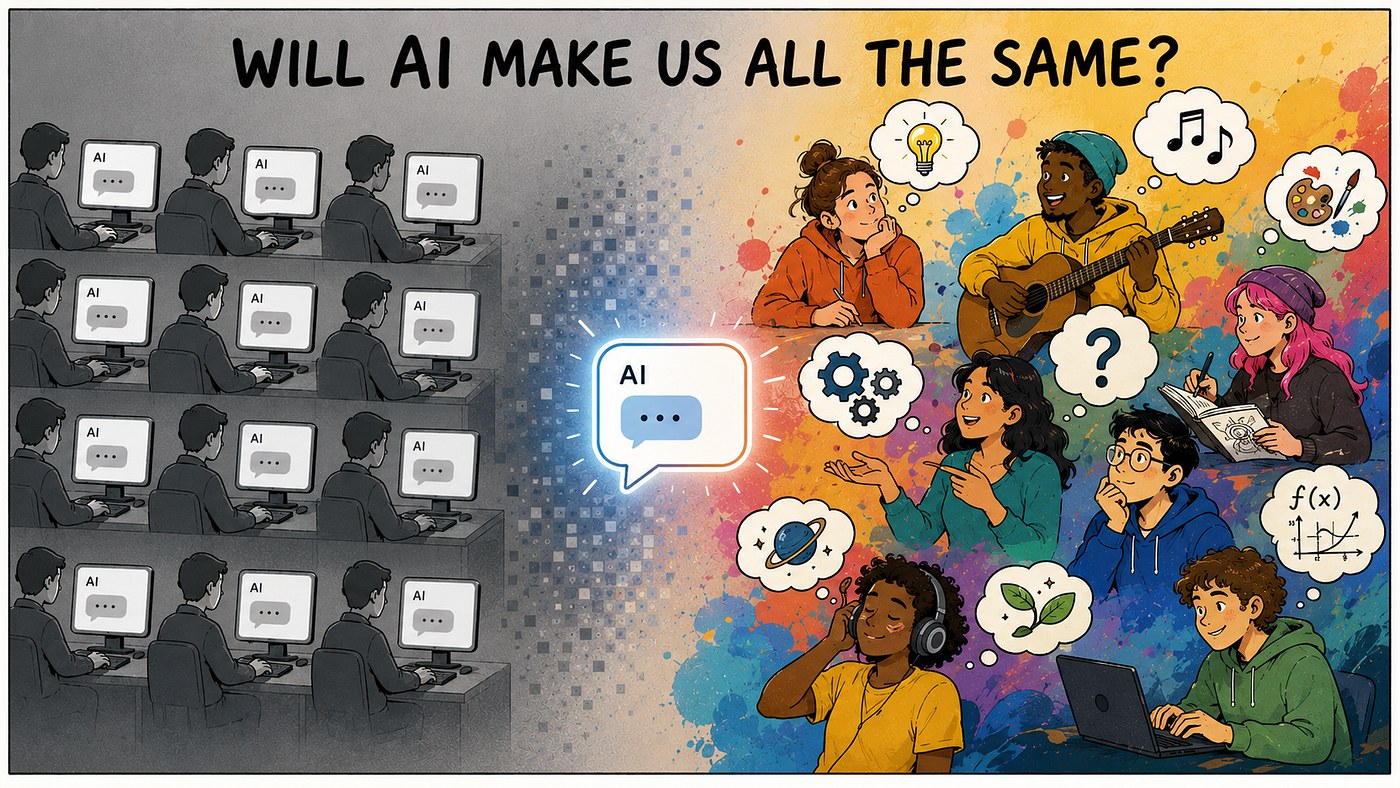
Will AI make us all think alike? The research says it's complicated.
I've been using various LLMs daily for the past two years. Last month, I noticed something unsettling: when I asked three colleagues to draft the same project proposal using AI, all three came back with nearly identical structures. Different words, same skeleton.
That got me wondering — are we all slowly converging into some kind of algorithmic consensus? Turns out, I'm not the only one asking this question. Scientists have been studying it, and the answer is way more nuanced than I expected.
The Evidence: Yes, AI Does Homogenize Output (But Not Always)
The Individual vs. Collective Paradox
A recent study published in Nature Human Behaviour found something paradoxical: when people used ChatGPT for brainstorming tasks (like coming up with gift ideas or repurposing household items), their individual ideas scored higher on creativity. But when you looked at all the ideas together, they were significantly less diverse than ideas from people working without AI.
The researchers put it bluntly: ChatGPT made ideas better on average, but more similar to each other.
This wasn't a small study either. Another experiment with 800+ participants across 40 countries found that high exposure to AI-generated examples didn't make individual ideas more creative, but it did change the collective landscape. The researchers' exact words? "AI made ideas different, not better."
The Quality-Homogenization Tradeoff
Here's where it gets interesting. Researchers analyzed 6,875 student essays written under five different conditions: human-only, AI-only, and three different human+AI collaboration modes.
The results showed what they called a "Quality-Homogenization Tradeoff" — essay quality improved significantly with AI assistance, but structural diversity collapsed. Cohesion architecture lost 70–78% of its variance.
Think about that. The essays got "better" by conventional metrics, but they all started looking like they came from the same template.
The good news? The effect varied by dimension. While structure became more uniform, perspective plurality actually increased in some cases. And crucially, the type of prompt mattered — more specific prompts could reverse homogenization into diversification.
It's Not Just Writing Style — It's Cultural Expression
A study on AI suggestions and cultural expression revealed something even more concerning. When Indian participants used AI writing assistance, their text became measurably more similar to American writing — not just in style, but in content choices and cultural framing.
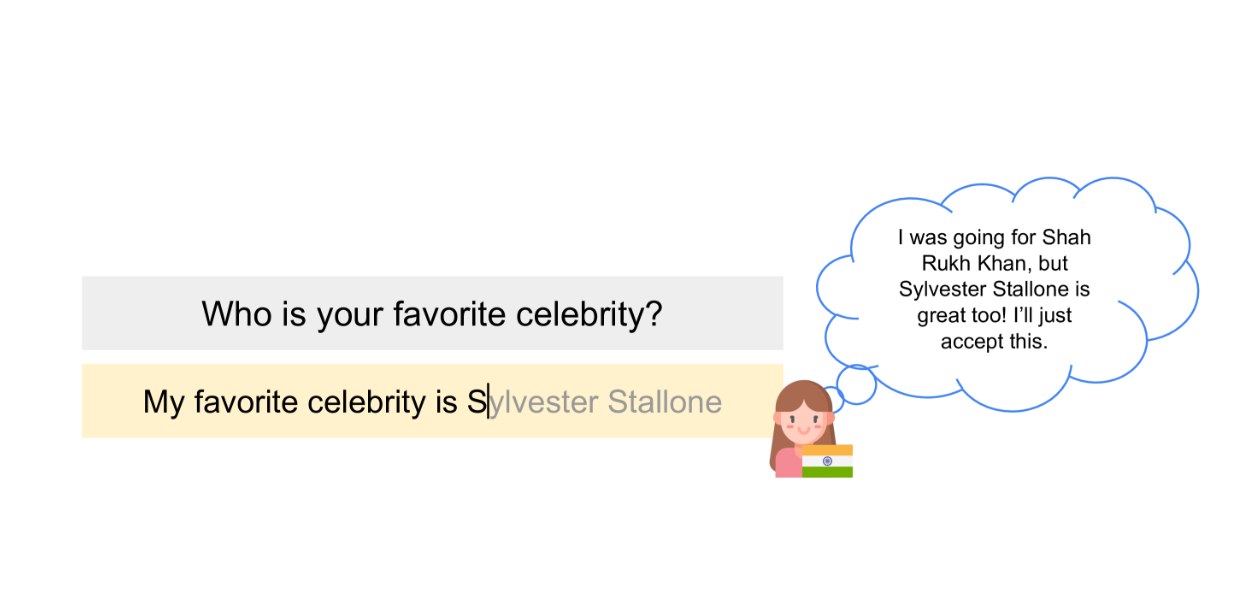
The effect size was large (Cohen's d = 0.91). With AI suggestions, participants started describing their own cultural artifacts — food, festivals — from what researchers called a "Western gaze."
This isn't just about everyone sounding the same. It's about AI quietly pulling everyone toward dominant cultural patterns.
The Counterargument: AI Can Actually Increase Diversity (Under the Right Conditions)
Multiple AI Personas Break the Pattern
A controlled experiment tested whether diverse AI inputs could preserve creative diversity. Instead of giving everyone the same AI-generated story plots, researchers created 10 different AI personas and had them generate 300 varied plots.
Result? Story diversity was preserved, and in some conditions, even enhanced compared to human-only baselines.
The researchers' conclusion was critical: "The trade-off may emerge from uniform deployment practices rather than from an inherent limitation of GenAI."
In other words, the problem isn't AI itself. It's that we're all using the same AI, the same way, with the same default settings.
Task Type Matters More Than You Think
An OpenReview paper pointed out something obvious in hindsight: homogenization isn't always bad.
For standardized tasks — math problems, formatted reports, code cleanup — convergence toward a common pattern is actually desirable. You want consistency.
The danger zone is creative and judgment-heavy tasks:
- Brainstorming
- Strategic decisions
- Personal expression
- Cultural narratives
These require divergence, not convergence. The issue is when people apply AI the same way to both types of tasks.
Human-AI Collaboration Isn't Always Better
A meta-analysis in Nature Human Behaviour reviewing multiple studies found that human-AI combinations often perform worse than either humans alone or AI alone.
The pattern? Creation tasks (writing, design) usually benefit from human-AI collaboration, but decision tasks often see performance loss. When humans outperform AI, collaboration creates synergy. When AI outperforms humans, adding human input can actually make things worse.
This suggests a different risk: not that everyone thinks the same, but that everyone develops the same low-intensity judgment habit — half-delegating, half-verifying, never fully committing to either human intuition or AI capability.
So What Actually Makes the Difference?
After reading through the papers (of course with the help of AI), I noticed a pattern.
AI doesn't flatten everything. It's really good at making your writing structure look the same — how you organize paragraphs, how you build arguments, even the rhythm of your sentences. But it's way less effective at changing what you actually think about something, or which problems you decide to care about in the first place.
USC researchers who analyzed 130+ studies put it this way: "The concern is not just that LLMs shape how people write or speak, but that they subtly redefine what counts as credible speech, correct perspective, or even good reasoning."
That last part is what scares me. It's not that we'll all write the same way. It's that we'll all start thinking the same things sound "smart" or "reasonable."
But here's the thing: homogenization isn't baked into AI itself. It's about how you use it.
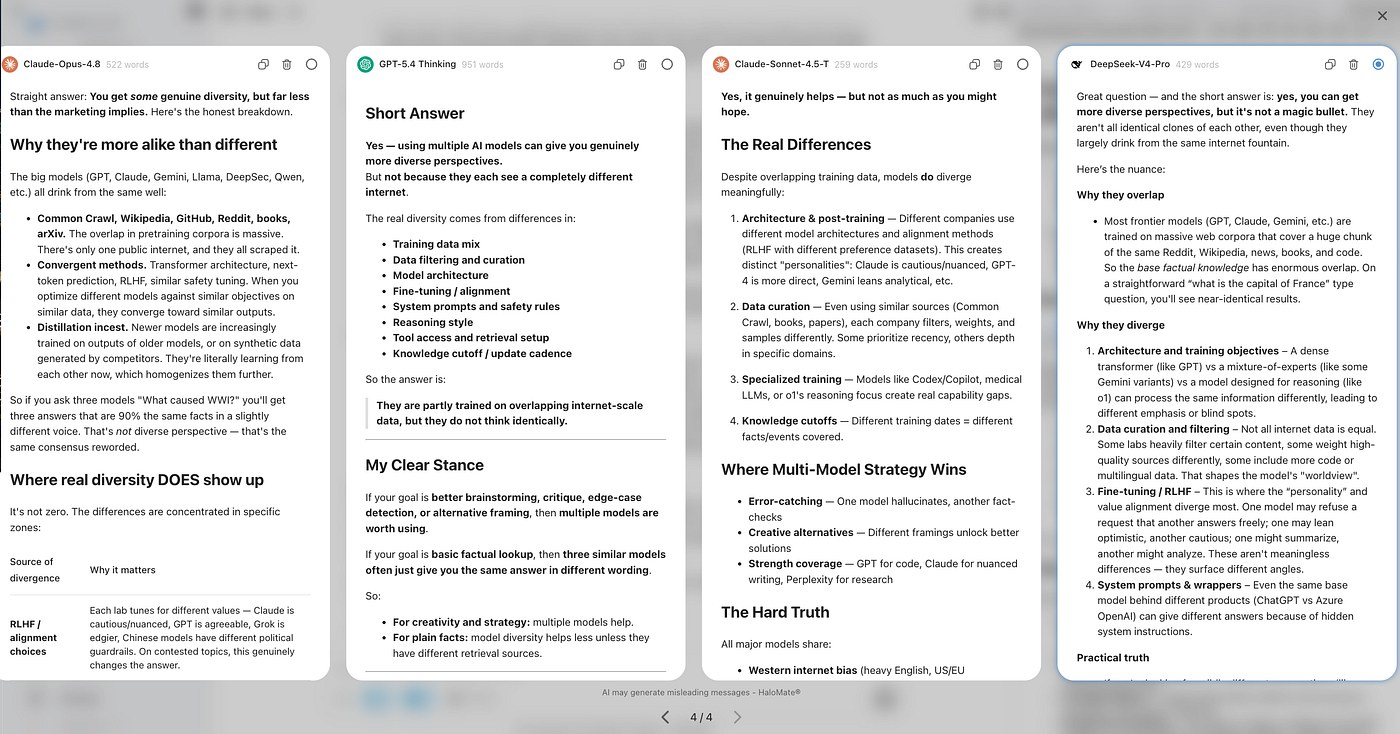
Use one model exclusively? You start sounding like that model. Use three different ones and make them argue? You're forced to pick a side, which means you're still deciding, or merging.
Hit "send" and copy-paste the first result? You just adopted its structure. Go back and forth, challenge it, make it rewrite from a different angle? You're still in control.
A study on college students found that people who used AI early in a project actually got more creative in later stages — but only if they treated it like a sparring partner, not a vending machine.
The researchers' exact words: "Students predominantly engaged passively with AI, limiting deeper collaboration."
That's the whole game right there.
AI as a crutch → you end up sounding like everyone else.
AI as something to argue with → you might actually get sharper.
So Will We All Think Alike?
Here's my read after going through all this research:
AI doesn't automatically make everyone think the same. But it makes it very easy to end up there if you're not paying attention.
The real risks are everyone using the same model with the same defaults, mistaking "higher average quality" for "better thinking", losing cultural and stylistic diversity while metrics go up, and developing a habit of low-commitment, half-delegated judgment.
The protective factors? Multiple AI sources with different perspectives, specific varied prompts instead of generic ones, active engagement — treating AI as a tool to think with not instead of — and awareness of which tasks need diversity and which need standardization.
Why I've Always Run the Same Prompt Through Multiple Models
For any non-trivial decision or creative work, I run the same question through different models. Not to find "the best answer," but to see where they disagree. Claude might suggest a cautious approach, GPT might push for scale, Gemini might focus on user experience.
The disagreement is the point. It forces me to actually decide what I think, rather than just accepting the first coherent-sounding response.
I also keep project-specific context and memory so the answers sit side by side in one workspace — the AI isn't just regurgitating generic advice, but building on what we've already established. That way, even if the underlying model sounds similar to everyone else's, the output is anchored to my specific situation.
The USC team's review compared unchecked AI homogenization to Orwell's Newspeak — a system that narrows the range of expressible thought.
That sounds dramatic, but the mechanism is real: when billions of people use the same handful of models, and those models are trained to reproduce dominant patterns, the feedback loop is obvious.
But here's what gives me hope: almost every study that found homogenization effects also found ways to mitigate them. Diverse inputs, better prompts, active engagement, multi-model approaches — they all work.
The question isn't whether AI will make us all think alike. It's whether we'll build the habits and systems that preserve the friction, disagreement, and diversity that make collective intelligence actually intelligent.