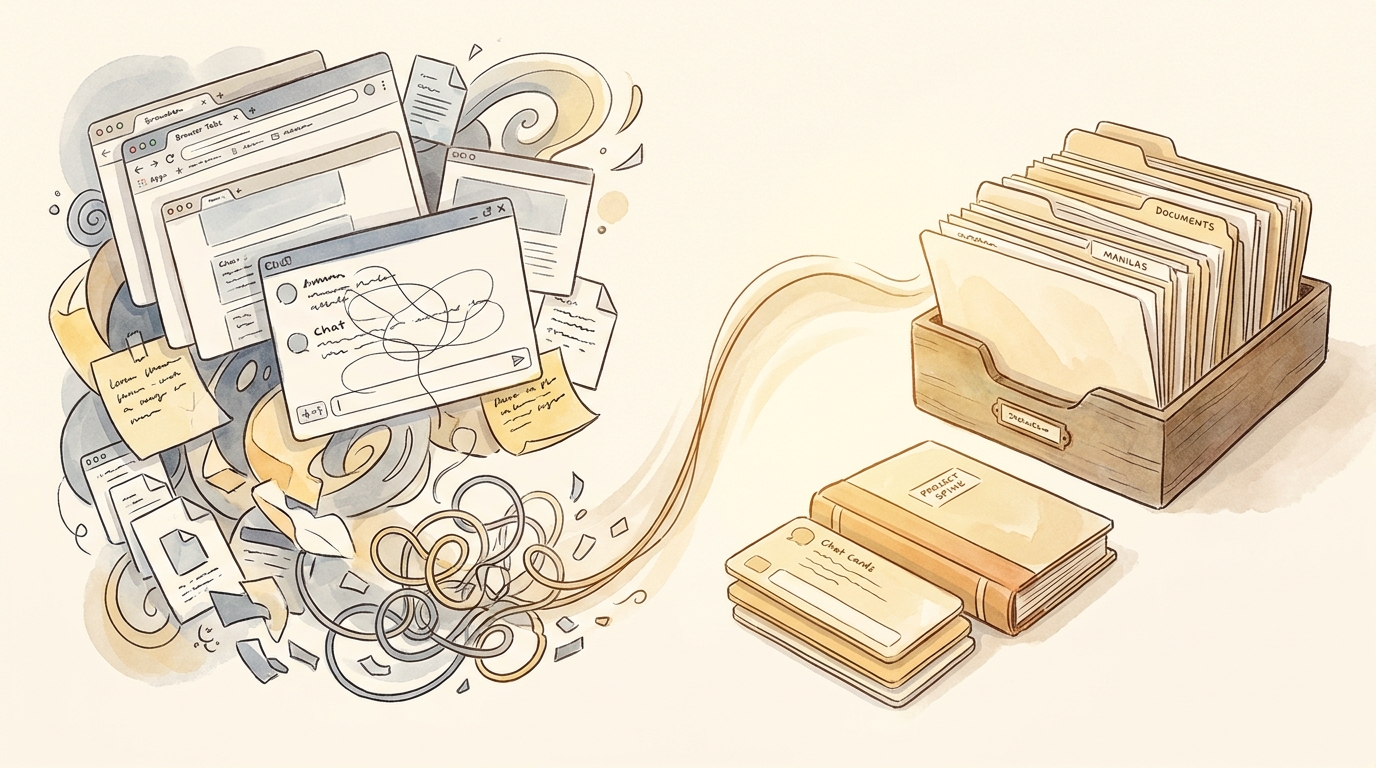
When I'm working on something real — a product launch, a vendor evaluation, a campaign plan — I'm not asking one clean question. I'm researching, brainstorming, drafting, revising, and cross-checking. That's easily five to ten separate conversations, each building on the last.
In most AI tools, every new chat still feels like day one. Re-upload files. Re-explain the brief. Copy-paste the only good paragraph from yesterday into today's tab. I become the only person (or process) holding the full picture. That gets old fast.
This is not a tutorial for one product. It's the shape of the problem I hit, what I tried, and what finally made multi-model work stop feeling like logistics.
What I tried (and where each fell short)
I started as a heavy ChatGPT user. Then my company pushed Gemini for work. Over time I stopped treating multi-model as a hobby. Different models fail in different ways. For decisions I have to defend, I want a second and sometimes a third pass — same material, different brain.
That pushed me into aggregators and switchers: Poe, ChatHub, HaloMate, and a little OpenRouter.
ChatGPT Projects. Grouping chats and uploading files once for the project is genuinely useful — see OpenAI's own Projects docs for how they describe it. In my use it does not always feel like it read the file the way I would. I've watched it cite something that wasn't there, or skate past a detail I know is on page six. The larger break for me: if I want Claude (or anyone else) to stress-test the same draft against the same PDFs, I leave the project and rebuild somewhere else.
Claude. File handling is often more thorough when the set is small. Accuracy feels better until you stack four or five PDFs and bump the context ceiling. Then behavior shifts toward search-ish retrieval. Fine in theory; in practice I feel less sure what actually sat in context.
Gemini. Paid tiers let you carry files across chats, but the center of gravity is still Gems and per-assistant setup more than a ChatGPT/Claude-style project spine. Good for some loops. Weak for one multi-week initiative with many conversation branches.
HaloMate. Became my daily home months before I wrote the Medium version of this note. Mid-thread model switch without losing the room, assistants with their own memory, drafts and files in one hub. Not a ranking — just the stack the later sections are grounded in.
Poe. Excellent for sampling many models in one account. Knowledge tends to sit on the bot, not on the project. Same research pack on Claude and GPT often means two bots and two knowledge bases.
The pattern I kept walking into:
I could have persistent context inside one tool, or I could have model diversity. Rarely both in the same room without me as the USB cable.
Why multiple models (when the files are shared)
I've gone long on this in older posts; short version here. Models don't only differ in "style." They miss different things. One summarizes cleanly and skates past a logical hole. Another is sharp on structure and clumsy on tone. For anything that ships with my name on it, first draft from one model, challenge from another, occasional third as tie-breaker, then I decide. (Four AIs reviewing each other is the louder version of the same habit.)
That loop only stays cheap if every pass sees the same project files and the same intermediate artifacts. Otherwise the workflow is copy-paste theater.
When "Projects" stopped meaning "one model's folder"
For a long stretch on HaloMate I still ran work as separate chats plus custom assistants (they call them Mates — same idea as a role with memory, not a model tattoo). I re-uploaded files more than I want to admit. Habit tax.
When Projects showed up there, my bar was low. I'd already met ChatGPT Projects and Claude's file habits. After a few real days in a single project, the thing that mattered wasn't branding. It was a boring sentence: chats inside the project can see the same library, and I can put outputs back into that library on purpose.
I spun up a sample project tagged like a launch — call it "Q1 Product Launch" for this write-up. Source pack, uploaded once:
- PRD / one-pager
- Competitor pricing sheet
- Brand guidelines
From there, every new chat in that project could cite those files without another upload carnival.
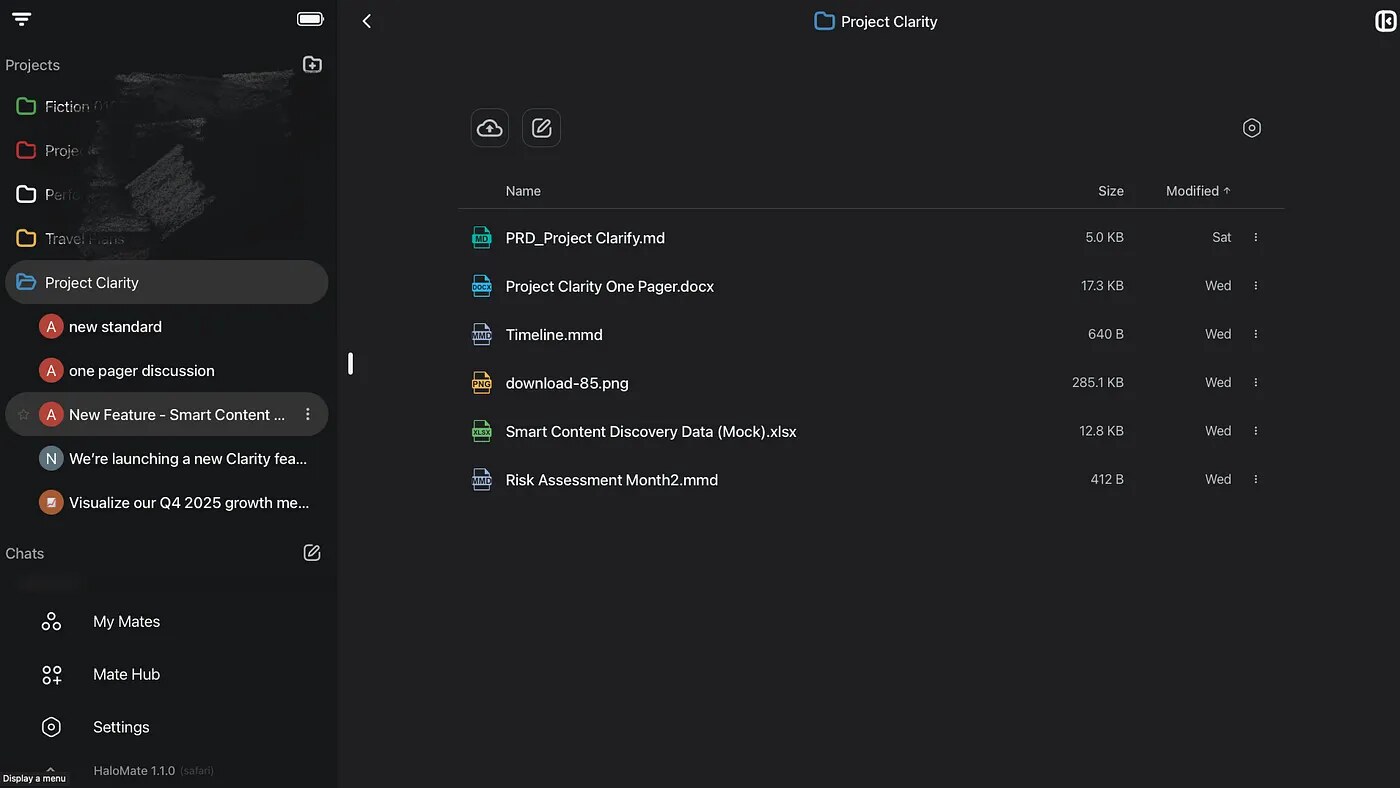
A typical shape (illustrative, not a one-day miracle)
This is a compressed sample. In real weeks these steps often sit days apart, waiting on humans.
Chat 1 — strategy. Role set up for strategic pushback. Prompt shape: given the PRD and pricing pack, where is differentiation actually defensible? I get a positioning sketch (sometimes a matrix). If it's good, I save that artifact into the project — not the whole messy thread.
Chat 2 — pricing. Different role, data-heavy. It reads the matrix I saved plus the pricing sheet, and proposes a range with a comparison table. Again: keep the table if it earns a seat; trash the chatter.
Chat 3 — messaging. Copy-focused role. It sees guidelines + the strategy/pricing artifacts and drafts taglines that are at least arguing with the same facts.
Three conversations. Different assistants. Same spine of files and saved outputs. No re-teaching the industry report every morning.
If this sounds adjacent to writing an employee handbook for AI teammates, it is. Personas hold how someone works. The project holds what the work is about.
What I keep vs what I throw away
Not every reply deserves permanence. The win is selective: one sharp risk list, one diagram, one paragraph that finally names the tradeoff. Whole transcripts are usually sludge. The project should grow like a brief, not like a landfill.
That's also how the workspace stops being "a folder of chats" and starts being something that compounds — same pressure I wrote about when I stopped treating export into Docs as the start of thinking.
The good, the bad, the dumb PDF
File behavior differs by tool and by week. In my current setup, large docs often feel like "find the relevant slice" rather than "stuff the entire 20k-word PDF into the window." Upside: fewer hard context-full walls than I've hit in Claude with several big PDFs, and less of the "confident but thin" cite pattern I still sometimes get when a tool is clearly thrifty with tokens. Downside: you have to stay awake. Searchy systems can still miss.
Hard limit I hit: OCR-scanned PDFs with no text layer. I burned a stupid amount of time re-uploading and restarting before admitting the file was basically a picture. Not mystical. Just a bad input.
Also: this whole multi-conversation, multi-model spine is overkill if you're happy inside one lab's ecosystem and most tasks are single-shot. ChatGPT Projects or Claude with a tight file set may be enough. Complexity is not a virtue.
What this actually bought me
I'm not selling a universal stack. For my work I needed:
- Several conversations on one initiative without losing the plot
- Different roles (or modes) on different slices of the work
- Cross-checks across models on shared evidence
- Less of my week spent being middleware
The setup is not magic. It's less friction. Models will keep getting "smarter" on benchmarks. If you still re-teach them the same brief every Monday, that intelligence doesn't compound for you.
Takeaway
I used to spend a loud share of AI time on logistics: uploads, tab bridges, re-explaining. I want that time on decisions.
If you're juggling tools and you're the only long-term memory in the system, try a project-shaped home for the work — whatever product actually fits how you already think. For some people that's ChatGPT Projects. For some it's Claude's file-heavy habits. For me it's a multi-model workspace (HaloMate in my case) where assistants, models, and a shared file layer can sit in one place.
The missing piece wasn't a prettier chat box. It was multiple conversations, different assistants, same spine of context — and me not having to be the spine.