I still export.
That is the first thing worth saying, because the title sounds cleaner than real work. My company still lives in Docs, Slides, and shared drives. Review comments still show up in those tools. Formal decks still need the company template. HaloMate is not where my team collaborates. It is where I think.
What changed is not "export disappeared". What changed is what export is for.
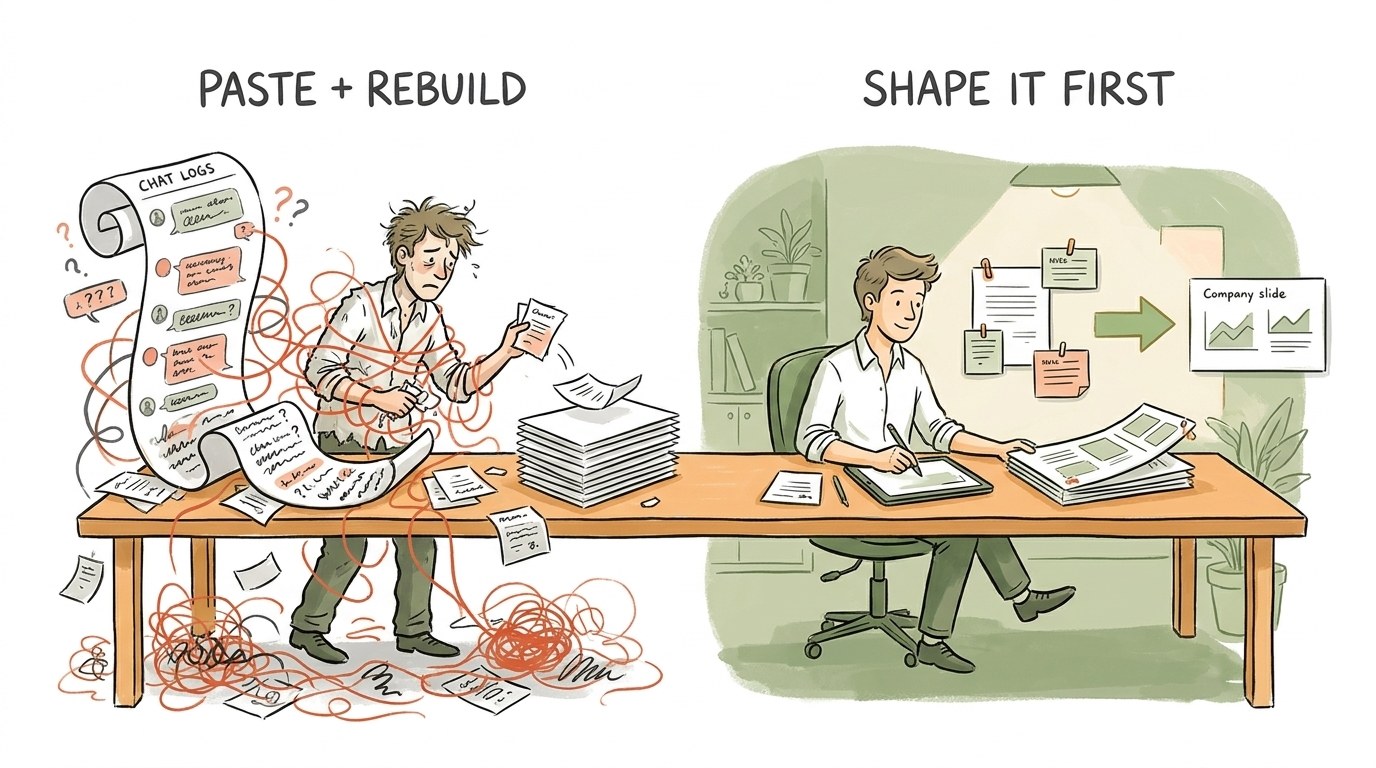
For a long time, export was where the real work started. AI gave me a long answer in chat. I pasted it into Docs. Then I rebuilt structure, redid tables, fixed tone, and tried to remember which version of the argument I actually believed. The chat was a sketchbook. Docs is where I started pretending the answer was already a deliverable.
Now the construction happens in my personal workspace first. Export is the handoff into company tools, not the moment I start making sense of the work.
The tax I was paying after the "good answer"
The AI part of my job got faster last year. The part after the AI answered often did not.
A typical week looked like this. I needed a feature evaluation deck for stakeholders. Not a masterpiece. Eight to ten slides. Clear recommendation. Risks. What we would measure next.
I could get a strong analysis in chat in twenty minutes. Then the boring half began:
- Paste the analysis into Docs and reshape it into something a human would actually read.
- Pull numbers into a separate sheet because the chat table never survived the trip cleanly.
- Rebuild charts in Slides.
- Notice the deck and the chat no longer agreed on one assumption.
- Go back to chat, re-ask, re-copy, re-align.
None of that was "using AI". That was me acting as glue between a smart answer and a file other people could open.
I used to blame myself for being messy. Then I started timing it. The generation was not the expensive part. The rebuild was. And the rebuild had a second cost I ignored for months: once the polished version lived only in Docs or Slides, the messy reasoning that produced it died in a chat log. Next month, same theme, slightly different feature, I was starting half-cold again.
I have rebuilt the same risk slide from chat notes more times than I want to admit.
That is the export tax. Not the click that downloads a file. The tax is treating company docs as the first place your thinking becomes real.
The bad loop I trained myself into
If you only need a rewritten email or a one-line explanation, exporting early is fine. I still do that on my phone.
The problem shows up when the output is supposed to become a deliverable you will defend in a room.
In those cases I had trained myself into a bad loop:
- Ask AI.
- Get something "pretty good".
- Leave the AI environment immediately.
- Rebuild the artifact in Docs or Slides while the context is still fresh in my head.
- Hope I do not lose the thread before Friday's review.
The loop makes AI look useful in demos and expensive in real weeks. You get the dopamine of a strong first draft, then you pay in rework and in forgetting why you believed the recommendation in the first place.
I did not need a smarter paragraph generator. I needed the personal side of the work to stay intact long enough that export became boring.
The standard I switched to
I stopped asking "is this answer good enough to paste?"
I started asking three uglier questions:
- Can I keep working on this in the same place tomorrow without rebuilding context?
- Is the structure already close to the artifact I will actually present?
- When I export, am I handing off a draft, or am I still inventing the draft in Docs?
If the answer to number 3 is "still inventing", I am not done. I am just moving the mess into a prettier window.
My workspace became the place for project context that has to last: briefs, prior decisions, rejected options, notes from last review, the messy tables nobody else needs to see. Company tools stayed the place for shared editing, template compliance, and distribution.
That split matters because this is a personal brain for me, not a team OS. I am not trying to move my whole company into it. I am trying to stop using chat as a disposable scratchpad for work that clearly wants to become a file.
Same deck, different shape of work
Before
- Research and analysis in chat.
- Recommendation logic living only in my head and a long answer.
- Tables rebuilt by hand.
- Slides assembled under time pressure.
- After the meeting, the only thing left was the deck. The why behind it was already fading.
After
I keep one project for that product area. Not a chat. A project. Prior notes, last month's similar evaluation, open questions from leadership, and the current brief all sit there.
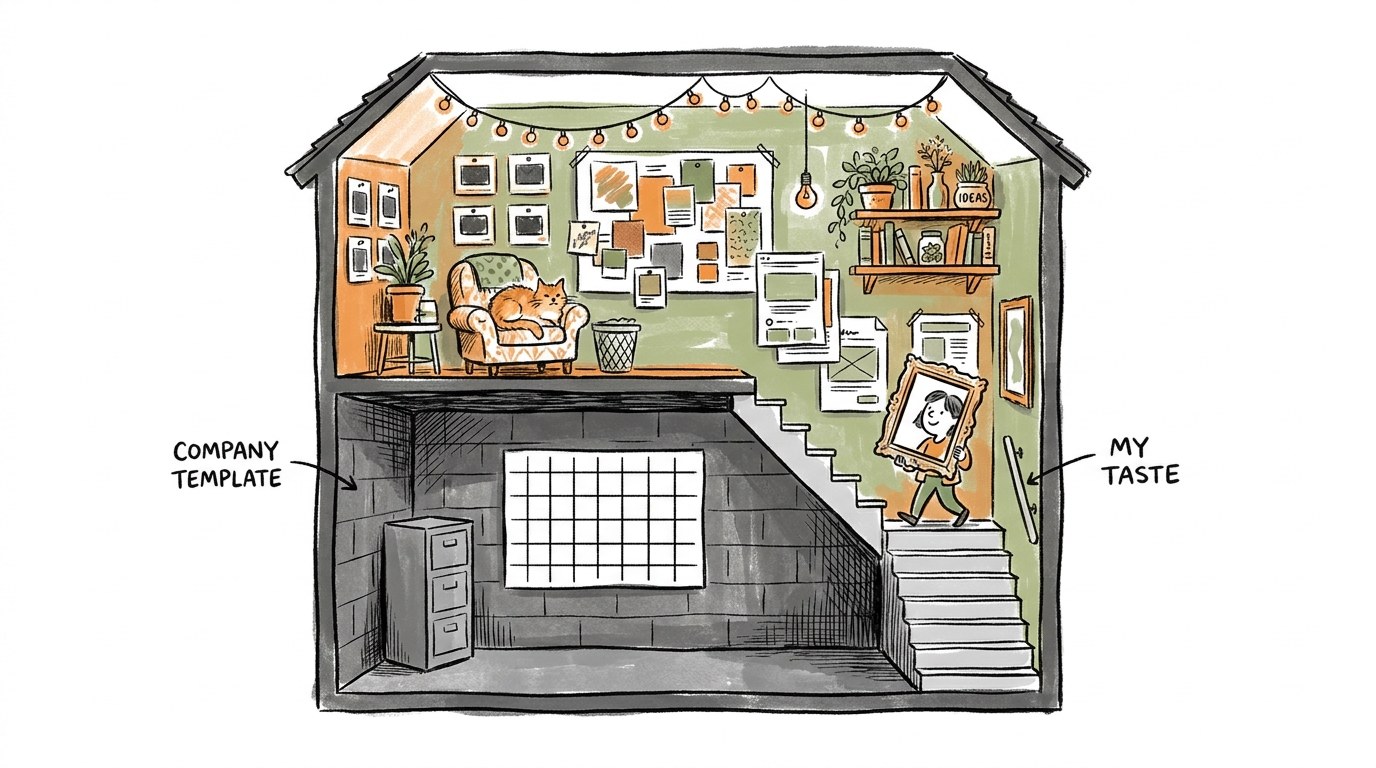
One quiet setup step made this less painful: I import whatever export of the company slide template I can get into the project once. It is never perfect. Title masters still break. Fonts go missing. But starting at something like 70% company-shaped is different from starting at a blank white slide.
I collect slide styles I actually like when I see them. A deck that made a hard recommendation feel calm. A sparse layout that made numbers readable on a phone. A title pattern that did not sound like a press release. When a new deck starts, that note sits next to the brief.
I still care more about how I sound than about perfect brand compliance on draft one. The company template keeps me from inventing a new visual language every week. The taste note keeps the draft from sounding like every other PM deck in the shared drive.
I do the thinking in that project first. Frame the decision in plain language. Run the recommendation against a hostile read, sometimes with a second model when the room will be rough. Shape the narrative into slide-sized claims, not essay paragraphs. Generate the tables and charts while the assumptions are still attached to the analysis. Produce a deck draft that already sits on the imported template, so I am editing an artifact, not pasting into a blank corporate shell.
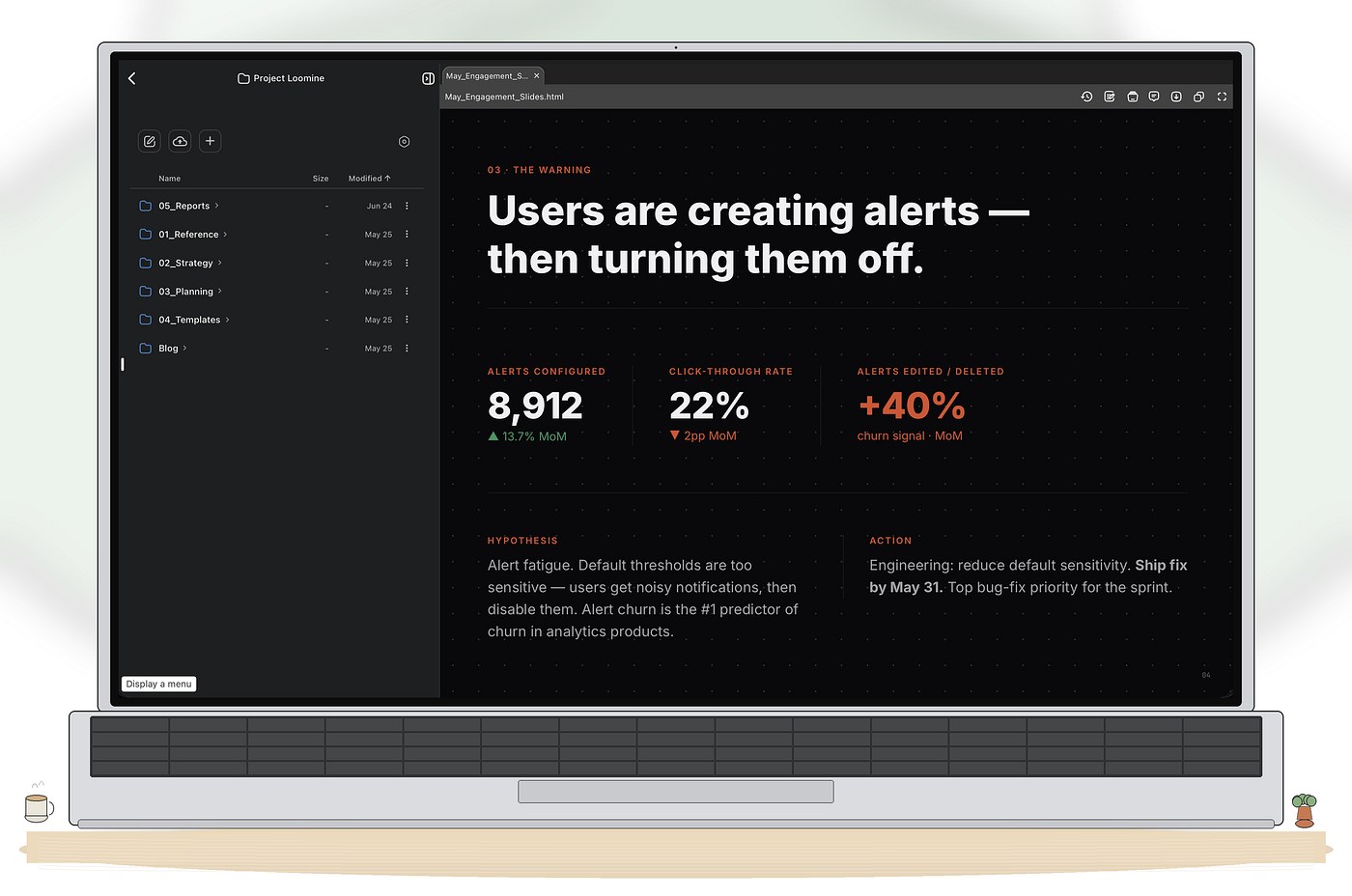
Only then do I export into company systems.
What I export now is not "AI said some words". It is closer to a real first cut: order of argument, backup numbers, risk section, recommendation up front, already wearing something close to the official format. In company Slides I still do the last layer other people will see:
- Fix anything the template import did not catch.
- Handle title-slide politics and last-mile branding.
- Share it for comments.
- Accept the edits that come from people who were not in my head.
That last part never leaves company tools. It should not. My teammates are not going to live in my personal AI workspace, and I would not ask them to.
The difference is where the hard thinking finishes. It used to finish during the paste-and-rebuild. Now it mostly finishes before the paste.
Why I am not waiting for an agent to drive my laptop
The other common answer I hear is: let an agent operate Docs and Slides for you. For software work that path is getting real fast. For my setup it mostly triggers a security concern.
I do not want an AI roaming my laptop with broad access to files, browsers, and whatever else happens to be open while I am juggling work and life. Maybe that fear is conservative. Fine. I would rather keep the heavy thinking inside a workspace with a clearer boundary, finish the personal draft there, and export only the slice that needs to enter company systems.
I do not need an AI that operates my machine. I need an environment where analysis can become a file without me acting as the integration layer for an hour.
What I still export, on purpose
I still export for collaboration. Always.
I also still leave the personal workspace when:
- Final branding or legal review has to happen in the official shared file.
- Multiple people need to comment in the same doc in real time.
- The artifact has to live in a system of record I do not control.
Those are not failures of the workflow. Those are the handoff.
The concession I want to make clearly: if your work only counts when five people are inside the same file, a personal AI workspace will not replace your suite. It should not pretend to.
What it can replace is the hour where you are the only person who understands the half-built logic, and you keep re-explaining it to a blank document.
The loop that made this stick
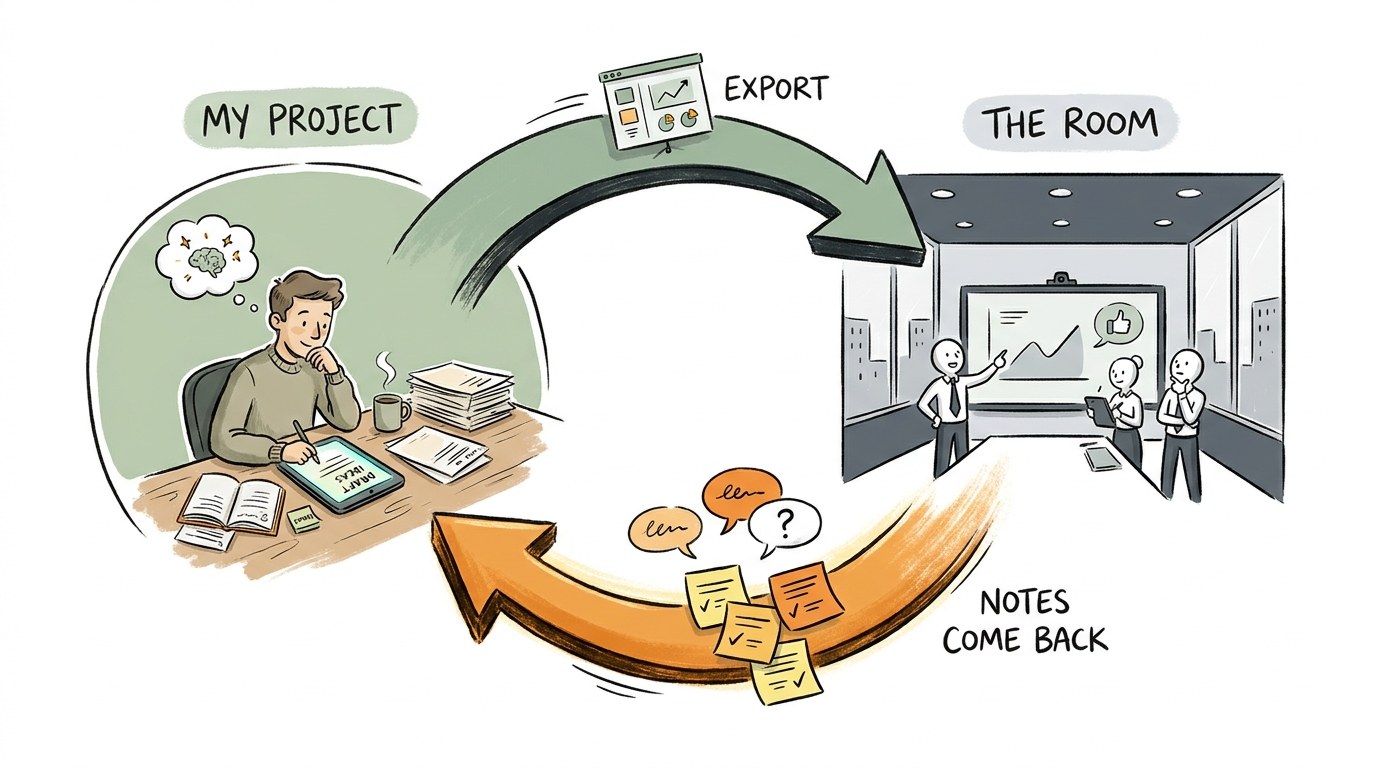
Export used to feel like the end of AI help. Now the useful loop runs both ways.
Before a review, I finish the personal draft in my workspace and export into company Slides.
During or after the review, when feedback shows up, I throw it straight back into the same project. I do not wait until I "have time to reorganize". I drop it in while the context is hot.
Last month a stakeholder wrote one line on slide 6: "Why is this higher priority than the auth rewrite?" That note went back into the project the same afternoon, next to the original recommendation and the risks I had already accepted. I revised the personal source of truth in place, then exported a cleaned update when the deck needed another round.
If insights only flow chat to Docs and never return, you still have a disposable brain. You just have nicer formatting on the way out.
If feedback can re-enter the same project, next month's evaluation is not a new personality. It is a continuation.
What actually changed for me
Not a fantasy of zero friction.
Export stopped being construction. I still format in company tools. I rarely rebuild the argument there from a wall of chat text.
My personal context got heavier in a good way. The project holds the evolving judgment, not only the final PDF. That is the long-term deposit. The deck is a withdrawal.
Review days got less brittle. When someone challenges slide 6, I am not searching my memory for "which chat said that". I reopen the project, update the reasoning, and push a cleaner cut.
There is also a quieter change in standards. I am less impressed by a beautiful answer that cannot survive contact with a real file. Pretty text is cheap now. A draft that is ready to enter company process is not.
I still get a second read when a decision is expensive. I still write the final human sentences myself when the room is political. None of that went away. The glue work went down.
If your AI answers already look good
Look at the twenty minutes after the answer.
Do you stay in the same environment and keep shaping the artifact? Or do you immediately become a courier between chat and Docs, hoping nothing important falls out of your pocket on the way?
I stopped treating that courier job as normal.
I still export into the tools my company actually uses. I still need templates, comments, and shared ownership. What I refused to keep doing was letting the first real version of my thinking be born in a paste buffer.
My AI workspace is a personal brain with files, memory, and drafts that can become real documents. Company tools are where work gets social.
Once I accepted that split, export stopped feeling like failure. It started feeling like the last step, and sometimes the step that sends better notes back home.
For me the work used to die in the rebuild after the chat. That is the part I stopped treating as normal.