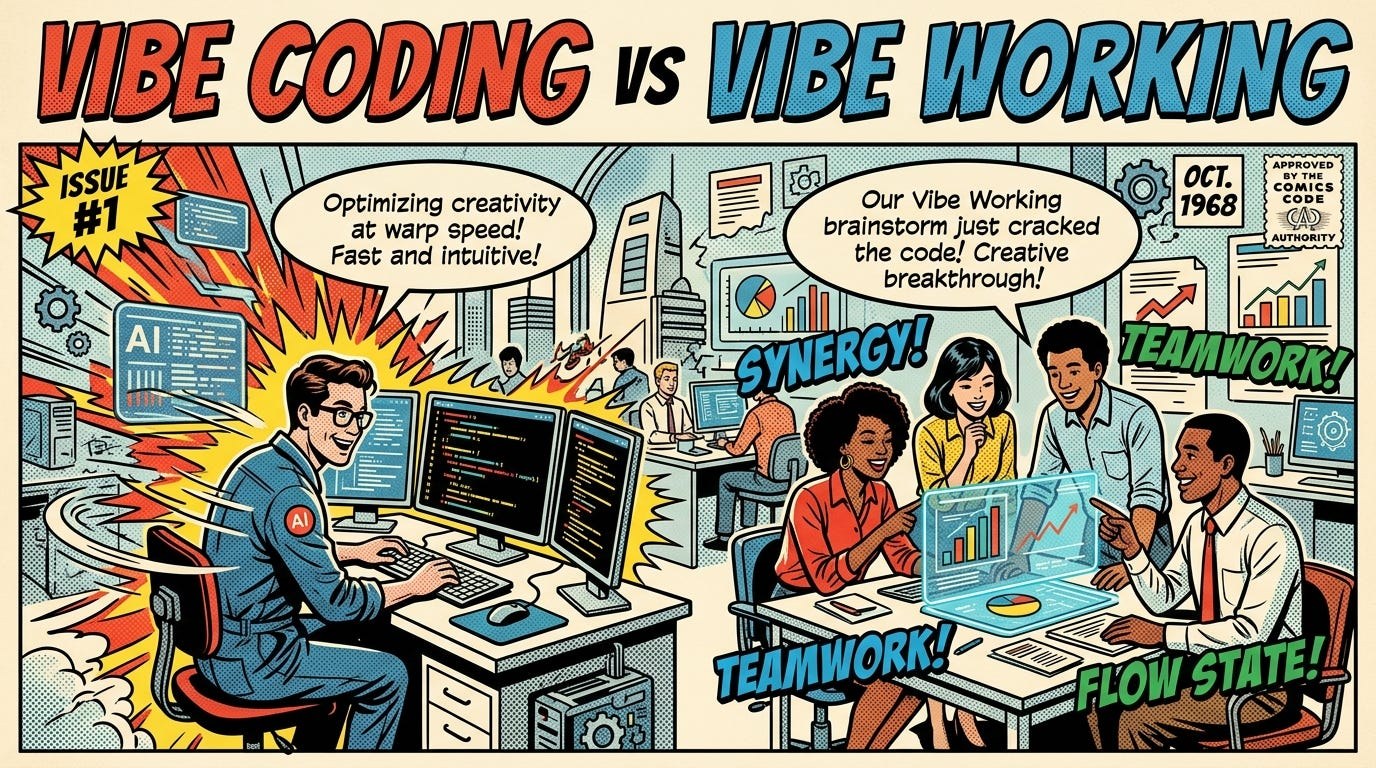
The same problem that broke developers' trust in AI-generated code is now showing up in knowledge work. You can generate a polished report in minutes, but can you explain how you got there?
Vibe coding promised anyone could build apps by talking to AI, and honestly, it kind of delivered. I've seen non-coders ship working prototypes in a weekend — tiny dashboards, internal tools, landing pages, little apps that would have taken weeks to brief, scope, and wait for before AI showed up.
But then developers started looking under the hood.
A Stack Overflow writer built a bathroom review app with Bolt. It worked well enough to feel impressive. Then someone with more development experience reviewed it, and, in her words, "the holes began to show".
I keep coming back to that line because it is not really a coding problem — it is a credibility problem. And I think the same thing is now happening across knowledge work.
Not with apps. With strategy docs. Market research. Competitive analysis. Stakeholder reports. Decks. Vendor evaluations. All the polished AI-assisted work that looks fine until someone asks one simple question:
"Can you show me how you got here?"
Vibe coding was the warning shot
The term "vibe coding" was coined by Andrej Karpathy in early 2025. His description was basically: fully give in to the vibes, embrace the exponentials, and forget that the code even exists.
Simon Willison later made a useful distinction: not all AI-assisted programming is vibe coding. To him, vibe coding means building software with an LLM without reviewing the code it writes.
Using AI to help write code is not the problem. Developers have been using autocomplete, Stack Overflow, libraries, templates, and code generation for years. The problem is when the output becomes a black box. You ask for an app, the app runs, you keep prompting until it looks right, then you ship it without really understanding the structure, the tradeoffs, the security risks, or what future-you just created for future-someone-else.
Developers get nervous not because AI wrote some of the code, but because someone may now be responsible for code they cannot explain, maintain, or safely change.
Vibe working is the same pattern in a nicer outfit
Vibe working is what happens when the same behavior moves from software into everyday professional work.
You ask AI for a competitive analysis and it gives you a clean table. You ask for a strategy memo and get a confident narrative. You ask it to summarize customer feedback and suddenly you have five neat themes with executive-friendly wording. The work looks good, and sometimes it is good.
But then someone asks:
- Where did this number come from?
- Why did you trust this source?
- What alternatives did you consider?
- What assumptions are baked into this recommendation?
- Did you check the opposite argument?
- Why are we making this decision instead of the other one?
And that is where a lot of AI-assisted work starts to wobble.
I wrote more directly about this in Vibe Working: When Hiding Becomes the Job, but the short version is this: many professionals are already using AI heavily at work, but they are not always comfortable admitting it.
Microsoft's 2024 Work Trend Index found that 75% of knowledge workers use AI at work, and 78% of AI users bring their own AI tools to work.
KPMG and the University of Melbourne's 2025 global AI study found something even more uncomfortable: 66% of people regularly use AI, but only 46% are willing to trust AI systems. The same report says 66% rely on AI output without evaluating accuracy, and 56% have made mistakes in their work because of AI.
People are using AI, benefiting from AI, but also not fully trusting the outputs — and sometimes shipping them anyway. That gap is vibe working.
The real issue is auditability
The more I think about it, the less I think this is about coding at all — it is about auditability.
Bad vibe coding is not bad because AI wrote the code. It is bad because the next person cannot understand why the code works, where it might break, or how to safely change it. Bad vibe working has the same problem: nobody can see the assumptions, sources, tradeoffs, or reasoning path behind the polished conclusion.
In both cases, the output may be useful. It just is not trustworthy yet.
This is the part that gets missed in a lot of AI productivity talk: speed is not the same as ownership, a clean output is not the same as a defensible output, and "the AI said so" is not a professional explanation.
The credibility test is different, but the failure is the same
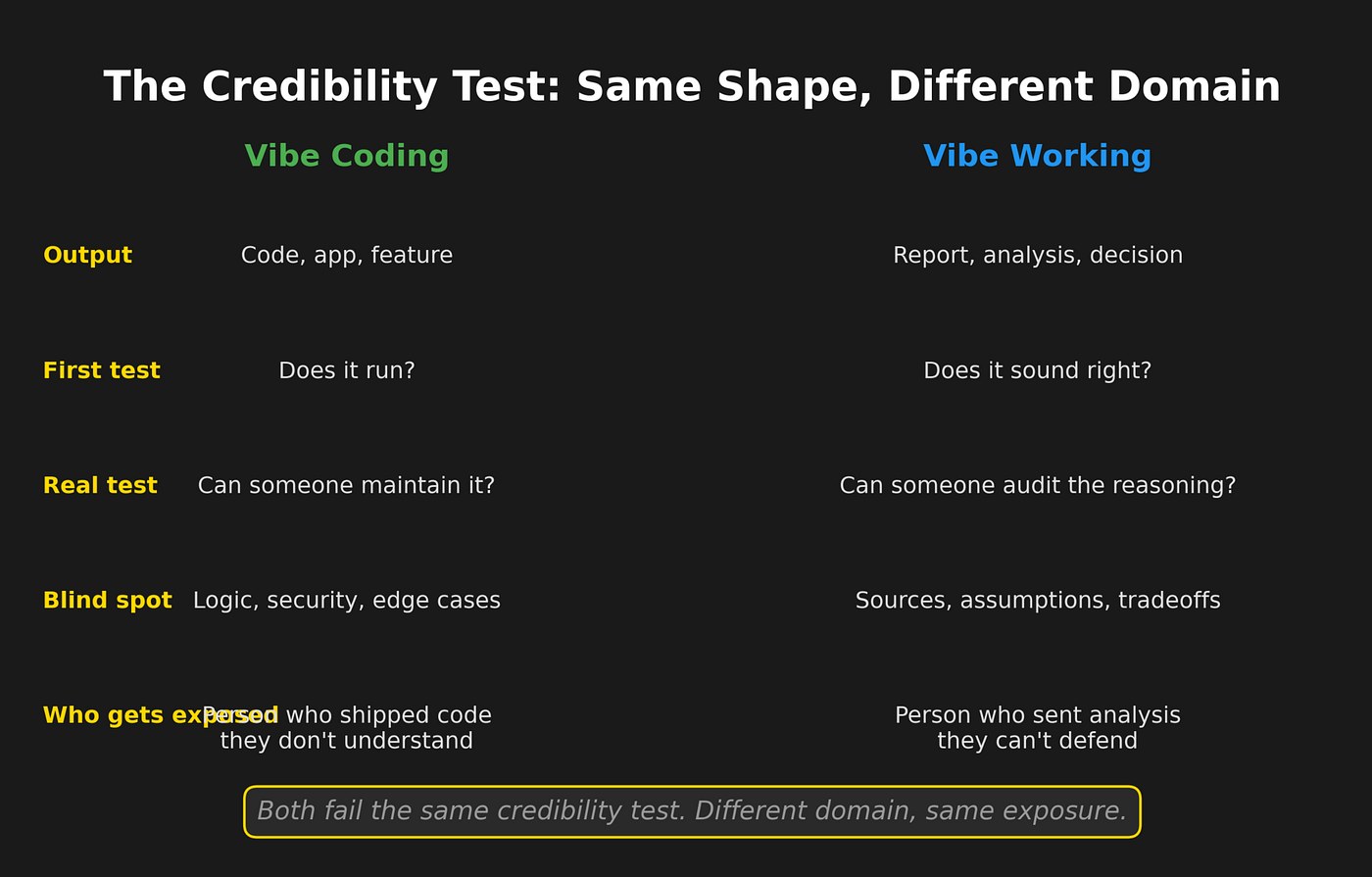
Vibe coding and vibe working do not fail in exactly the same way — code is not a strategy memo, a dashboard is not a board update. But the credibility test has the same shape.
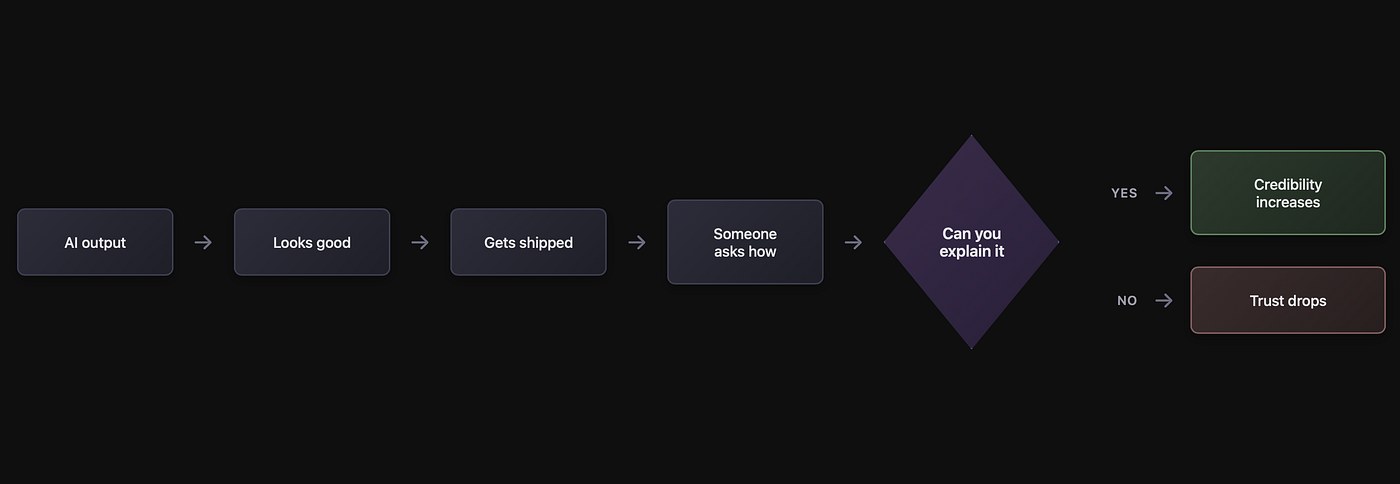
The first test is usually shallow: does the app run, does the memo sound smart, does the slide look executive-ready? The real test comes later, when another human has to trust it.
Showing your work does not always mean citations
This is where I think knowledge workers sometimes copy the wrong lesson from research tools.
Yes, citations matter. If a number appears in a market analysis, I need to know where it came from.
But in most professional work, "showing your work" is bigger than attaching ten links.
Sometimes it means showing the assumptions you started with, the alternatives you considered, the risks you chose to ignore, the counterargument that made you slow down, or the reason you trusted one conclusion over another.
A citation can prove where a fact came from, but it cannot prove that your judgment was sound. And that is why vibe working is tricky. The dangerous outputs are not always hallucinated facts. Sometimes the facts are fine, but the logic is thin, or the conclusion is too confident, or the recommendation ignores the thing everyone in the room already knows but nobody wrote into the prompt.
This is very PM-core, honestly. Half the job is not "find information" — it is knowing which information matters, which tradeoff is acceptable, and which answer will survive contact with stakeholders.
I still vibe. I just do not vibe blind.
I do not think the answer is to stop using AI. That would be fake advice — most of us are not going back.
For professional software, someone still needs to understand the code before it ships. For professional knowledge work, someone still needs to understand the reasoning before it goes to a manager, client, team, or customer.
The real question is not "did AI help create this?" but "can the human who owns this output explain how it was made?"
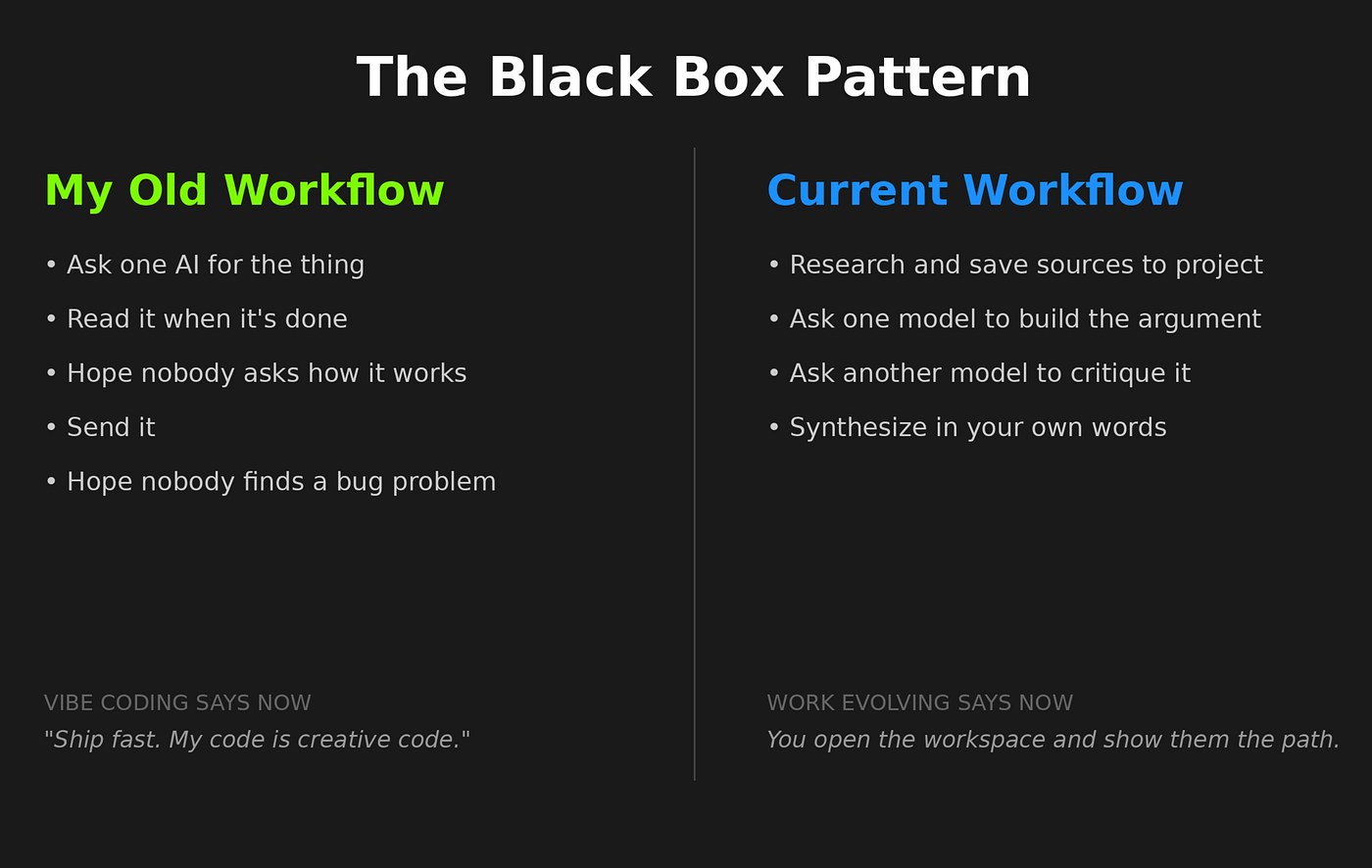
My old workflow was embarrassingly simple:
- Ask one AI for the thing
- Read it
- Clean up the wording
- Send it
- Hope nobody asks a question I cannot answer
My current workflow is slower, but less stressful:
- Start with research and save the useful sources into the same project
- Ask one model to build the first argument
- Ask another model to critique it
- Ask a third model when the first two disagree
- Pull out the assumptions, sources, and tradeoffs
- Write the final version in my own words
It is still AI-assisted, very AI-assisted, but now there is a trail.
If someone asks why I chose one recommendation over another, I can answer. If someone asks where the number came from, I can find it. If someone challenges the logic, I know which part came from the model and which part came from me — and that is the difference between using AI and hiding behind AI.
The future of vibe working is not less AI
Vibe coding is already evolving. The serious version is not "generate an app and never look at the code" — it is closer to agentic engineering, where AI writes, the human reviews, the human understands, and the human owns what gets merged.
Vibe working needs the same evolution: not AI as a magic document machine, but AI as a thinking partner that leaves enough of a trail for you to inspect, challenge, and defend the work. And that is where AI workspaces start to matter.
A normal chatbot is fine for quick questions — I still use them that way. But for real work, I do not want my sources in one tab, my draft in another tab, my model comparison in a third tab, and my final decision hiding somewhere in a copied Google Doc. That is how the black box comes back.
For vibe working to become real work, the workspace has to hold the context: the source material, the model outputs, the critiques, the edits, the final decision, and the memory of how you like to work.
This is why I care less about which model is "best" in isolation. A model gives you an answer, but an AI workspace helps you keep the reasoning alive long enough to use it professionally.
My simple rule now
If it is a draft, I can vibe. If it carries my name, I need to audit it. That is the line.
Vibe coding is not dead, vibe working is not wrong. Both are useful because they let people move faster, explore more, and make things they might not have attempted before. But vibing without verification is only safe when the stakes are low. The moment the output becomes a work product, speed is not enough — you need a way to show your work.
Not in a performative way, and not because every manager needs to see every prompt. Just enough that when someone asks "how did you get here," you do not have to pretend. You can open the workspace, trace the path, and own the answer.
To me, that is the real future of vibe working: not less AI, but less black box.