
I spent last week testing every "AI watermark detector" I could find. Here is the uncomfortable summary up front: as of mid-September 2026, there is no public tool anywhere that can verify a text watermark. Not for Claude. Not for Gemini. Not for anything.
That surprised me, because the watermarks themselves are real. Claude started watermarking text from new models launched on or after August 2 (Fable 5.1 and Mythos 5.1 so far, older models like Sonnet 5 and Opus 5 are still being retrofitted). Google's Gemini has carried SynthID text watermarks for years. The EU AI Act's transparency rules kicked in on August 2, and roughly 190 providers signed the Code of Practice that requires marking AI-generated content.
So the marks exist. The question everyone is asking, editors, teachers, hiring managers, and honestly writers checking their own drafts, is how to read them. I write with several models side by side, so I always know which paragraph came from which engine. Keep that in mind, it matters at the end. I tested five methods people are actually sharing online. Here is what each one really does.
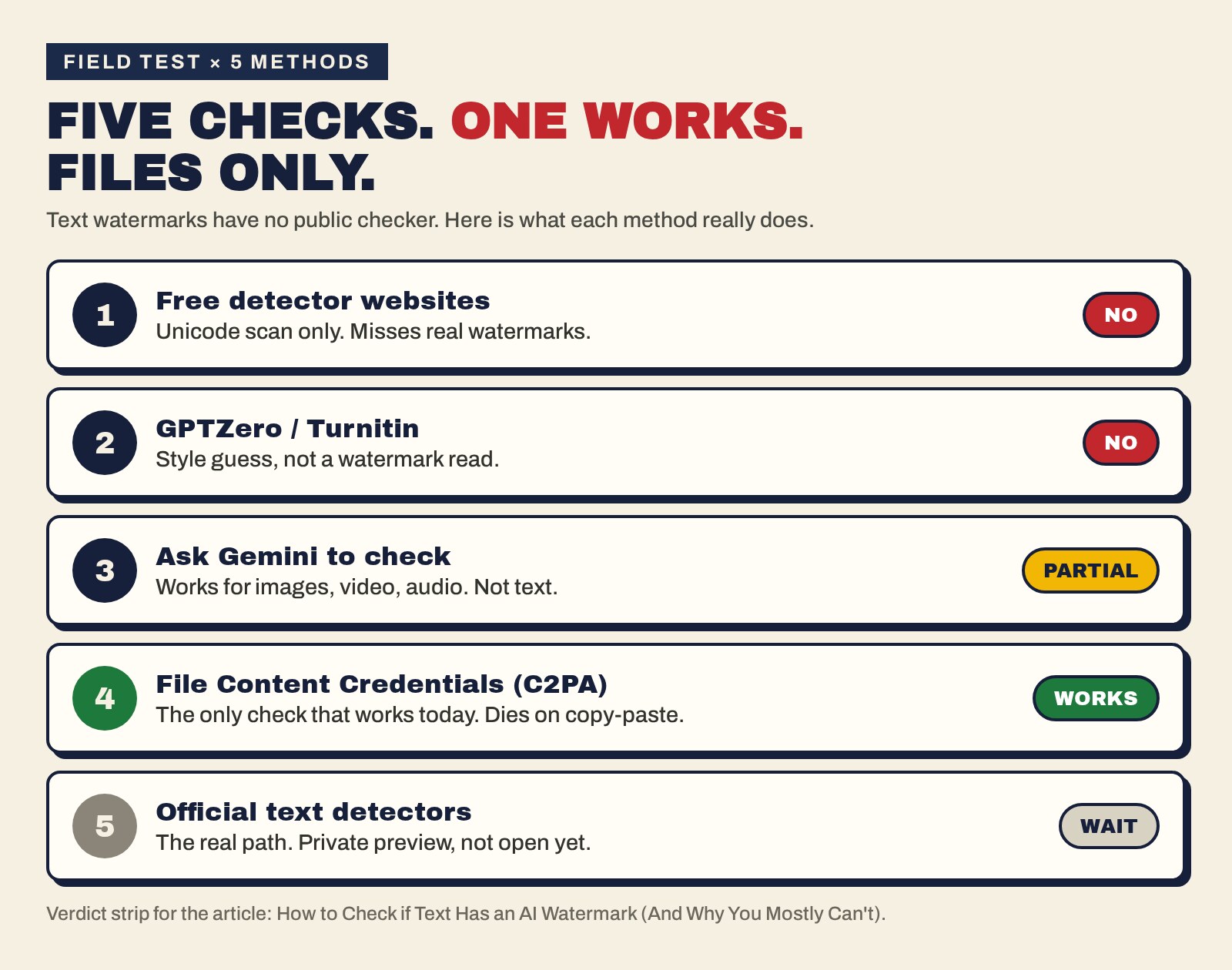
Method 1: Free "AI watermark detector" websites
Search "ai watermark checker" and you'll find a handful of free tools, watermarkdetector.com and gptwatermark.com being the most visible. They promise to detect hidden watermarks in your text, some specifically claim to find "ChatGPT watermarks".
I pasted in fresh output from a watermarked Claude model, generated that morning. Result: clean. No watermark found. (Independent testing confirmed Fable 5.1 output does carry the mark, so this is a failure of the checker, not an absence of the signal.)
That's because these tools scan for one thing only: hidden Unicode characters. Zero-width spaces, directional marks, invisible separators. Which is a real category of text manipulation, but it is not how modern AI watermarks work. Anthropic is explicit about this: Claude's watermark is woven into the word choices themselves, not hidden characters. Same for SynthID-Text, the Google DeepMind approach published in Nature that Claude's system is derived from.
And the "ChatGPT watermark" claim is worse than useless, because ChatGPT does not watermark its text at all right now. OpenAI watermarks images since May 19 and voice audio since July 31. Text: not deployed. One exception worth naming: StealthGPT now sells a dedicated "Claude Watermark Detector" that returns a detection score on pasted text. But there is no public key to check against, Claude text detection is still in private preview for vetted organisations, so no third-party page can run the real cryptographic test. A score without the key is a statistical guess wearing a watermark costume. Same verdict as the free scanners, newer packaging.
Verdict: does not detect any actual AI watermark. Fine as a Unicode hygiene check, nothing more.
Method 2: GPTZero, Turnitin, and other AI detectors
This is the most common confusion I see, and it's worth being precise about. GPTZero and Turnitin do not read watermarks. They never have.
Statistical AI detectors measure style: how predictable the word sequences are, how evenly paced the sentences run. They output a probability, a guess. Sometimes a decent guess, sometimes flagging a human's cover letter as AI. A watermark detector does something categorically different: it runs a cryptographic test for a specific signal that the AI vendor deliberately embedded, using a key only the vendor holds.
One is a vibe check. The other is reading a signature. The tragedy is that both get called "AI detection", so people assume a GPTZero score means "watermark found". It doesn't. It never means that.
Verdict: real tools, wrong job. A detector score is not watermark evidence, in either direction.
Method 3: Ask Gemini to check the content
Google actually shipped a consumer-facing verification path, and it's the easiest one to use: upload content to Gemini and ask if it was made by Google AI. Gemini checks for a SynthID watermark and tells you.
The catch, and it's a big one for our purposes: this works for images, video, and audio. Not text. You cannot paste a paragraph into Gemini and get a watermark verdict. Google also runs a dedicated SynthID Detector portal, but it's the same story, media files only, and access is still a waitlist being tested with journalists.
Think about what that means. Google has had text watermarking in production longer than anyone, they open-sourced the SynthID-Text code, and even they don't offer a public text checker. That's not an accident. The detection key is the whole ballgame; publish a checker and you hand everyone a free oracle for testing whether their edits stripped the mark. (I tested what actually strips it, quirks and all, in my Gemini SynthID piece.)
Verdict: genuinely works, but only for images, video, and audio. Text is explicitly out of scope.
Method 4: Check the file's Content Credentials (C2PA)
If what you received is a file rather than pasted text, a Word doc, a PDF, an image, you have one verification route that works today: C2PA Content Credentials. When Claude generates or edits a supported file it attaches signed provenance metadata, and OpenAI does the same for images. OpenAI also runs a public Verify tool that checks uploads for both C2PA metadata and SynthID marks, images and audio only, no text. Free inspection tools can read those signatures right now.
Two honest limitations. First, metadata lives in the file, so it dies the moment someone copies the text out into a fresh document, which is exactly what anyone hiding AI use would do. Second, absence proves nothing. No credentials just means no credentials survived.
Verdict: the only check that works today, but only for files, and only when nobody bothered to launder the content through copy-paste.
Method 5: Wait for the official detectors
For text, this is genuinely the state of the art: waiting.
Anthropic updated its explainer on September 1: a detection API now exists, but it is in private preview for eligible organisations, regulators, law enforcement, media, fact-checkers, researchers, educational organisations, EU civil society groups. If you are a teacher or an editor reading this, you are not on that list. The people who most want a paste-and-verify button are exactly the people who cannot get one yet.
And notice the careful language in the same document: even when the detector arrives, a detected mark means the content "may have been processed by Claude". Not written by. Processed. If Claude cleaned up a human draft's grammar, the mark can be there. Anthropic themselves say a positive result is not conclusive proof of authorship.
So the teacher's dream tool, paste in an essay, get a verdict, doesn't exist. And based on how the vendors are framing it, even v1 will answer a narrower question than most people want to ask.
While waiting, the only provenance that works today is the one you keep yourself. If you draft in one workspace where each paragraph remembers which model produced it (this is how I use HaloMate, one workspace, each paragraph traceable to its engine), you do not need a detector for your own drafts. That does not help you check anyone else, but it is the difference between guessing and knowing, at least for your own work.
Verdict: the only legitimate path for text, and it's not open yet.
What I actually took away from this
The folk methods circulating right now, zero-width character scanners, em dash counting, "just run it through GPTZero", all answer the wrong question or answer it with a guess. The real verification infrastructure is being built vendor by vendor, key by key, and text is deliberately the last thing being opened up.
My own workflow ended up in a strange place because of all this. I write with several models side by side, so the same document can pass through Claude, GPT, and Gemini without rebuilding context, which means I now know exactly which paragraphs carry a watermark and which don't, because I know which engine produced them. The recipient of my document knows none of that. That asymmetry, the writer knows, the reader can't check, is the actual state of AI text watermarking in 2026, and no free web tool changes it.
If you came here as an editor or a teacher hoping for a paste-and-verify button: it doesn't exist yet, and anyone selling you one today is selling you a Unicode scanner with a marketing budget.
FAQ
Can teachers or editors detect an AI watermark in text?
Not today. Claude's detection API is in private preview for eligible organisations (regulators, law enforcement, media, fact-checkers, researchers, educational organisations), not open to the public, and Google's SynthID verification (via Gemini or the Detector portal) covers images, video, and audio only. Statistical detectors like GPTZero estimate AI likelihood from writing style; they do not read watermarks.
Is there a free AI watermark checker that works?
For files and media, yes: C2PA Content Credentials inspectors work now, and Gemini can check images, video, and audio for SynthID marks. For text, no. Free sites claiming to detect text watermarks are scanning for hidden Unicode characters, which is not how Claude's or Gemini's watermarks work.
Does ChatGPT watermark its text?
No, not as of mid-September 2026. OpenAI applies SynthID watermarking to images (since May 19, 2026) and voice audio (since July 31, 2026), but has not deployed text watermarking. Any tool claiming to find "ChatGPT text watermarks" is detecting something else, usually stray Unicode.
If a watermark is detected, does that prove the text is AI-written?
No. Anthropic states that a detected Claude mark indicates content "may have been processed by Claude", which includes cases where Claude edited or reformatted human writing. Detection is a provenance signal, not an authorship verdict.
Does removing a watermark make text undetectable?
It removes the cryptographic signal, but statistical detectors judge style, not watermarks, so they may still flag the text (or falsely flag human text). I covered what actually happens when you try in my piece on removing Claude's text watermark.