Two weeks ago, Anthropic flipped a switch. Every piece of text Claude generates now carries an invisible statistical watermark, baked into the word choices themselves. Not hidden characters. Not metadata you can strip. The actual selection of words is the mark.
Copy it to Notepad. Paste it into Google Docs. Retype it by hand if you want. The pattern stays.
This happened because the EU AI Act’s Article 50 kicked in on August 2, requiring AI providers to mark generated content. Anthropic signed the Code of Practice. Google already had SynthID running on Gemini, which I tested separately. OpenAI hasn’t deployed text watermarking in ChatGPT yet, but they’ve built the tool and endorsed the same EU code. It’s coming.
So if you use Claude for writing, even just for editing or brainstorming, you’re now operating in a world where your output might carry a detectable fingerprint from whatever model touched it last.
The internet’s first reaction was predictable: how do I remove Claude’s watermark?
That’s the wrong question. But let me answer it anyway, because what you learn along the way is more interesting than the answer itself.
How Claude’s text watermark actually works
Here’s the short version, based on Anthropic’s own explanation and Sebastian Raschka’s technical breakdown.
When Claude generates text, it doesn’t pick words randomly. It uses a secret key combined with the preceding words to influence which token comes next. The output reads normally. You can’t see anything different. But if you have the key, you can check whether the sequence of word choices is statistically consistent with Claude’s watermarking pattern.
More text means more data points means higher detection confidence. Anthropic says short passages (under ~150 words) don’t carry enough signal to detect reliably.
Two important things to understand:
- The watermark can only answer “was Claude likely involved in writing this”. It can’t tell you if text is human-written, and it can’t detect other AI models.
- Each provider uses a different key and potentially a different method. Claude’s watermark is invisible to Google’s detector. SynthID marks are invisible to Anthropic’s.
This means every model leaves its own fingerprint, and no single detector can catch them all.
5 ways to remove Claude’s AI watermark
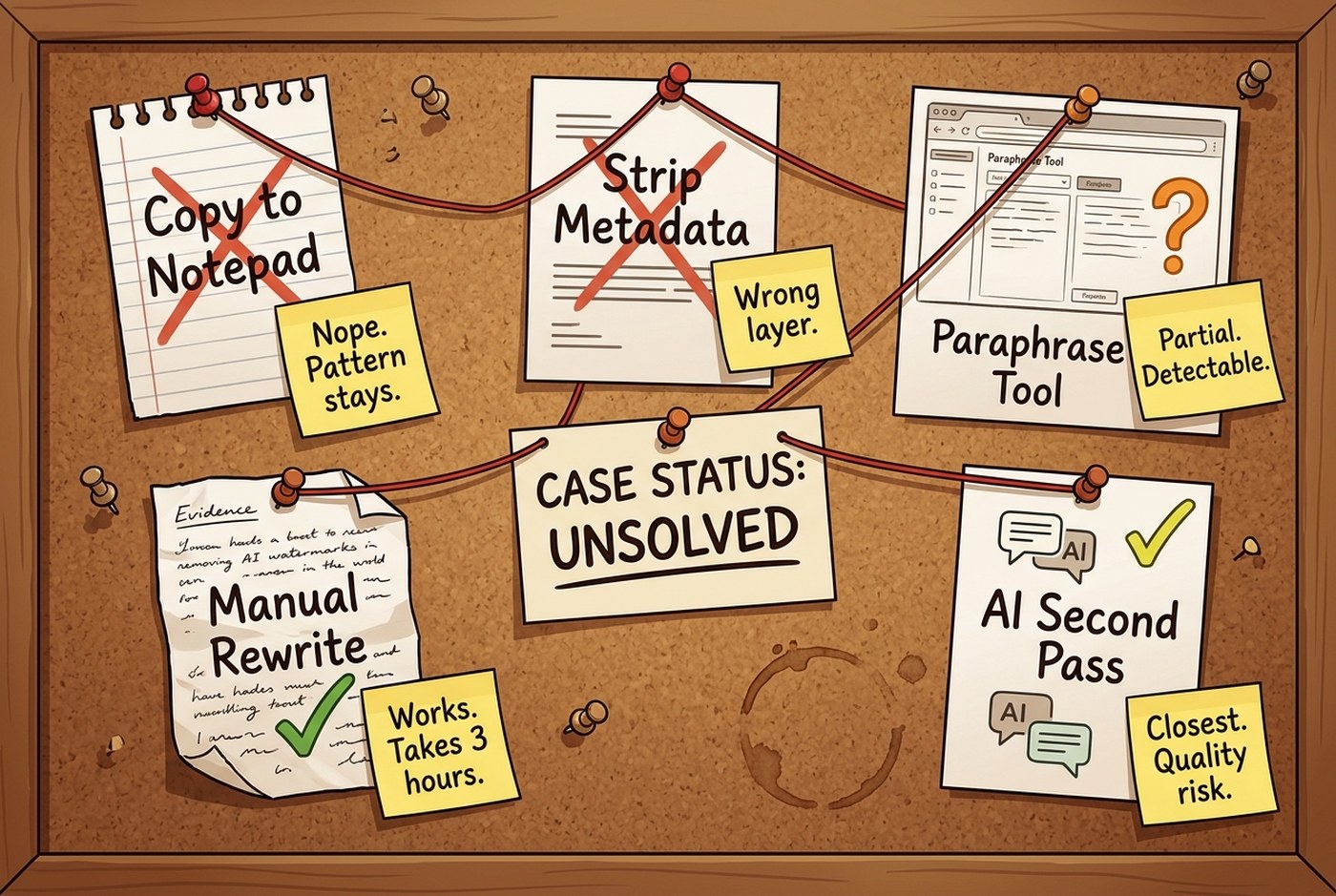
I tested five methods people are using to remove Claude’s text watermark. Here’s the quick summary, then the detail.
- The watermarks-remover GitHub Skill: uses Claude to rewrite Claude
- The translation loop: round-trip through another language
- Manual rewriting: nuclear option, always works
- Cross-model rewriting: run through a different AI model
- Multi-model workspace: what I actually do (the only one that improved my writing)
1. The GitHub Skill (watermarks-remover)
Guillaume Meyer published a Claude Skill that asks a second AI to swap word choices with synonyms. “Luminance” becomes “brightness”. “Commence” becomes “start”. The idea is that changing enough word choices scrambles the statistical pattern.
The catch: it’s still running inside Claude’s ecosystem. You’re using Claude to rewrite Claude. The new output might carry its own fresh watermark. Meyer himself admits results aren’t guaranteed to beat detection. And if you use a weaker model to do the rewriting, you’ll likely flatten your prose into generic mush, solving one problem by creating another.
2. The translation loop
This one showed up in the comments of every watermark article within hours: generate your text in German (or French, or Japanese), then translate it back to English using DeepL or Google Translate.
It’s clever. You’re running the output through two completely different language models, one that has no reason to preserve Claude’s token distribution. The statistical pattern almost certainly won’t survive the round trip.
But your writing quality takes a hit. Anyone who’s worked with machine translation knows the output reads… translated. Sentence structures get rearranged. Idioms get flattened. You’ll spend time editing the translation back into something that sounds like you actually wrote it.
3. Manual rewriting
The nuclear option. You read what the AI generated and rewrite it yourself, keeping the ideas but choosing your own words.
Anthropic’s own documentation acknowledges this: “a complete rewrite where every word is replaced will [remove the watermark]. In the latter case, of course, it’s arguable whether the text can any longer be described as AI-generated”.
It works perfectly, obviously. But at that point you’re just… writing. Which maybe was the point all along.
4. Cross-model rewriting
This is where it gets interesting.
If Claude’s watermark is a statistical pattern specific to Claude’s key, then running that text through a completely different model, say Gemini or GPT, fundamentally breaks the pattern. The second model has a different architecture, different training data, different token probabilities. It’s not swapping synonyms within the same statistical universe. It’s generating from a different universe entirely.
Multiple engineers have made the argument that text watermarks will always be trivial to remove, precisely because paraphrasing through a differently-watermarked model destroys the original signal. The Creators’ AI newsletter called this the future: “multi-model pipelines that regenerate structure.”
The logic is sound, but the execution is clunky. You generate with Claude, copy the text, open GPT in another tab, paste it in with a rewrite prompt, then compare the two versions. And at the end of it, your text now carries GPT’s statistical fingerprint instead. You haven’t removed the AI watermark problem. You’ve just swapped whose watermark you’re wearing.
5. Use a multi-model workspace (what I actually do)
This is my actual workflow, and it predates the watermark conversation by months. It’s essentially Method 4 done properly, without the tab-switching and copy-pasting.
I use HaloMate as my daily workspace. The setup is simple: I have different AI personas for different jobs, each with their own instructions and memory, and I can switch the underlying model on any of them without losing context. So when I’m drafting something that matters, the workflow looks like this: draft a section with Claude, switch to GPT and ask it to challenge the argument, switch to Gemini for a different structural take, then pick the pieces I actually want to keep. Same conversation, same context, no copying between tabs.
This does everything cross-model rewriting does, the statistical pattern gets broken because multiple models are contributing. But instead of treating the second model as a cleanup tool, each model is doing real editorial work. Claude tends to be careful and structured. GPT leans conversational and optimizes for what sounds good. Gemini often surfaces angles neither of the other two considered. DeepSeek can be bluntly direct in ways the Western models avoid.
The output is genuinely multi-model. No single model’s statistical fingerprint dominates because no single model wrote it. And unlike the translation loop or the synonym-swapper, nothing gets flattened in the process. Each model contributes its actual strengths, not a degraded paraphrase.
That’s not a workaround. It’s an editorial process. The watermark thing is just a side effect.
Why removing the watermark isn’t the real problem
All the other workarounds share one assumption: that you write with one model and then need to hide that fact. Generate, then cover your tracks.
The multi-model approach starts from a different place entirely. You’re not trying to dodge detection. You’re trying to get better output by refusing to trust any single model’s perspective. Once you see how differently these models reason about the same prompt, going back to a single-model workflow feels like asking one advisor and taking their word as gospel.
False positives, non-native writers, and what watermarks get wrong
There’s a deeper tension here that the removal tool crowd isn’t engaging with.
Does Claude’s watermark affect writing quality? If watermarks constrain word choices to embed a statistical signal, they’re literally making the AI’s writing worse on purpose. Every synonym forced by the watermark algorithm is a word Claude wouldn’t have picked on its own merits. John Gruber called it “a perversion of writing”, and that criticism landed hard for a reason.
And on the detection side, we still don’t have a good answer for false positives. What happens when a human writer, purely by statistical coincidence, produces text that resembles a watermarked pattern? Anthropic says their tool returns a likelihood score, not a binary yes/no. But we already know what happens when institutions treat probabilistic AI detection as certainty. A Stanford study found that AI detectors falsely flagged non-native English writing as AI-generated at an average rate of 61.3%, with some detectors unanimously misidentifying nearly 1 in 5 human-written TOEFL essays. Students have faced academic misconduct investigations over papers they wrote entirely by hand.
The watermark doesn’t solve the trust problem. It just moves it. Now instead of “did AI write this”, the question becomes “how much do we trust this detection score”. And the people most likely to get burned by false positives are the ones who can least afford it: non-native speakers, people with formulaic writing styles, students without the standing to push back.
What to do if you use Claude for writing
Here’s what I think matters, for anyone who uses AI as part of their writing process.
If you’re using AI to generate text you’ll publish as your own without meaningful editing, watermarks are the least of your problems. The output of any single model tends toward a predictable, detectable voice whether or not it’s formally watermarked. Readers can often tell. Editors definitely can.
If you’re using AI as a thinking partner, to brainstorm, to stress-test arguments, to explore angles, to draft sections you’ll heavily rewrite, the watermark is essentially irrelevant. Your final output is your own writing, informed by AI but not generated by it.
If you’re somewhere in between, using AI to draft and then editing substantially, a multi-model workflow is worth adopting. Not because it defeats watermarks (though it does, as a side effect). Because the quality of your output genuinely improves when you don’t rely on a single model’s perspective. You catch more blind spots. You get less sycophantic reinforcement. You end up with something that sounds like you, not like Claude or GPT or Gemini.
The watermark conversation feels urgent right now. Give it six months. Every major provider will have some form of text marking. The EU requires it. The detection arms race will continue. Tools to remove AI text watermarks will proliferate and improve. None of that changes the fundamentals of what makes writing good or useful or worth reading.
What does change the fundamentals is how you work with these tools. One model is a crutch. Multiple models in conversation is a workshop.
The watermark just made that distinction a little harder to ignore.
FAQ
Does Claude’s watermark affect SEO rankings?
No evidence so far. Google has consistently said it ranks content by quality, relevance, and helpfulness, not by whether AI was involved. There is no indication that Google crawlers detect or penalize watermarked text. The real SEO risk has always been publishing low-quality AI slop, not the watermark itself.
Does Claude watermark code output?
Anthropic’s announcement covers all Claude-generated text, but the practical impact on code is different. Code has rigid syntax and limited vocabulary, which means fewer opportunities to embed a detectable statistical pattern. The bigger tell for AI-generated code has always been style: variable naming, comment patterns, structure choices. If you’re using Claude Code or Claude for programming, the watermark is the least identifiable signal in your output.