When ChatGPT quietly pulled study mode this April, a Hacker News thread with 189 points spent a whole afternoon mourning it, and Ethan Mollick called the removal a big mistake. It has since come back as an @study command you type into the composer, which OpenAI's help page now documents, and the back-to-school articles about it are already piling up.
I was happy to see it return. I also don't think it was ever the thing standing between me and actually learning something.
Buried in that HN thread is a comment that describes my experience better than I could:
It typically started off like a structured lesson but as I chatted with it, it would forget the syllabus it had proposed and we never completed the thing we set out to learn.
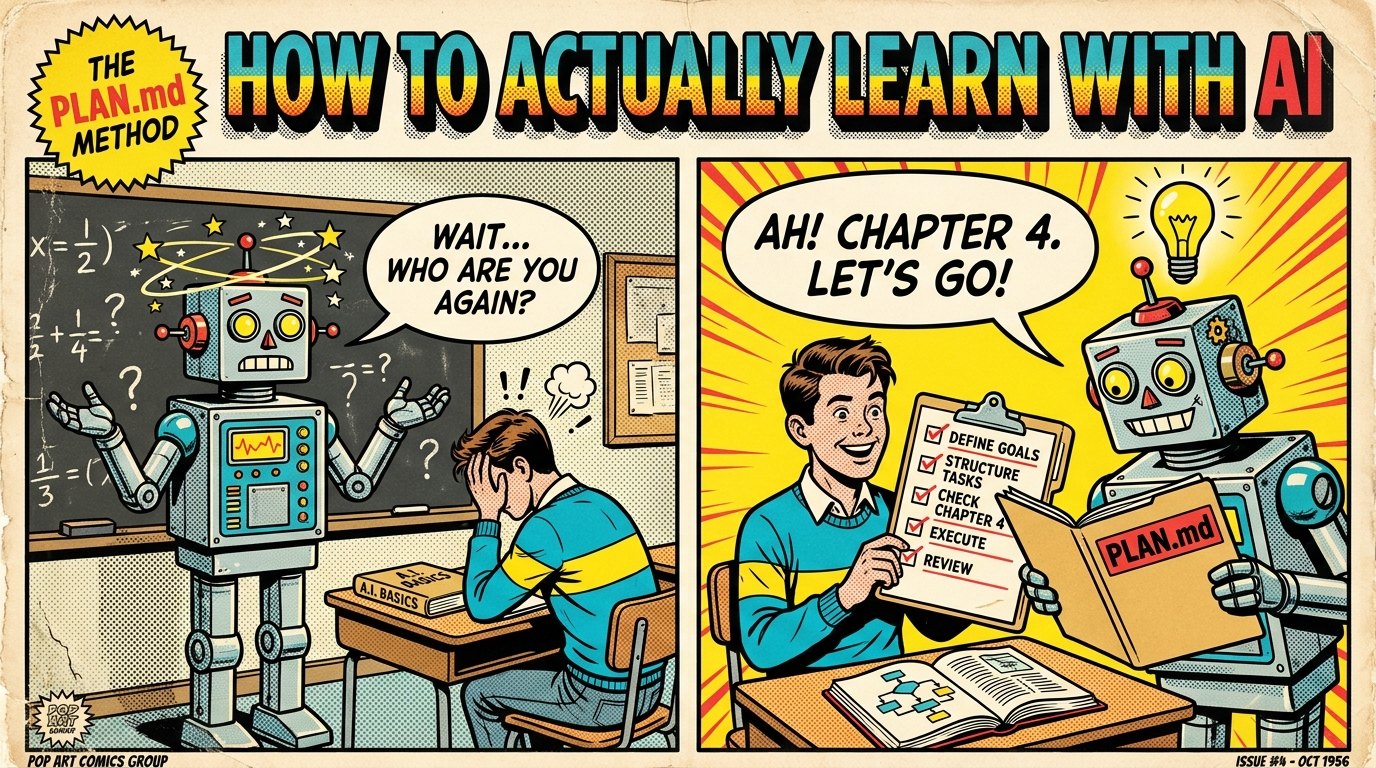
That's the whole problem in one sentence. Study mode is good at a single session. It asks you what you know, it holds back the answer, it checks your understanding. Then you close the tab, come back on Thursday, open a new chat, and you're a stranger again. There is no chapter three, because there was never a chapter one it can see.
Two things are going on here, and neither of them is about how clever the model is.
Problem one: there is no course, only conversations
A chat is a one-off. Whatever curriculum the AI proposed in the first message lives inside that scrollback and nowhere else. ChatGPT's memory feature will pick up bits ("user is learning statistics"), but it's lossy and it's not a syllabus. It will not tell the next session that you already did confidence intervals, that you got p-values wrong twice, or that the second explanation with the coin-flip example was the one that finally landed.
There's also a small, official detail that I think most people miss. Study mode doesn't work inside Projects, which is the one place in ChatGPT where you can keep files and standing instructions. So the feature designed for learning is locked out of the feature designed for continuity. You can have a tutor or you can have a folder, but not both in the same room.
Problem two: the teacher talks like a textbook that got nervous
The second issue is style, and I'll admit this one is partly taste.
I asked the same beginner question to three different models: "I keep hearing about statistical significance in A/B tests. What is it actually, in plain terms?" One gave me three paragraphs, one analogy about a rigged coin, and a question back to check I'd followed. Another opened with headers, bolded key terms, and laid out every edge case. The third wrote a longer version of the same coin analogy, then asked me to explain it back. Same prompt, same minute, three very different teaching styles.
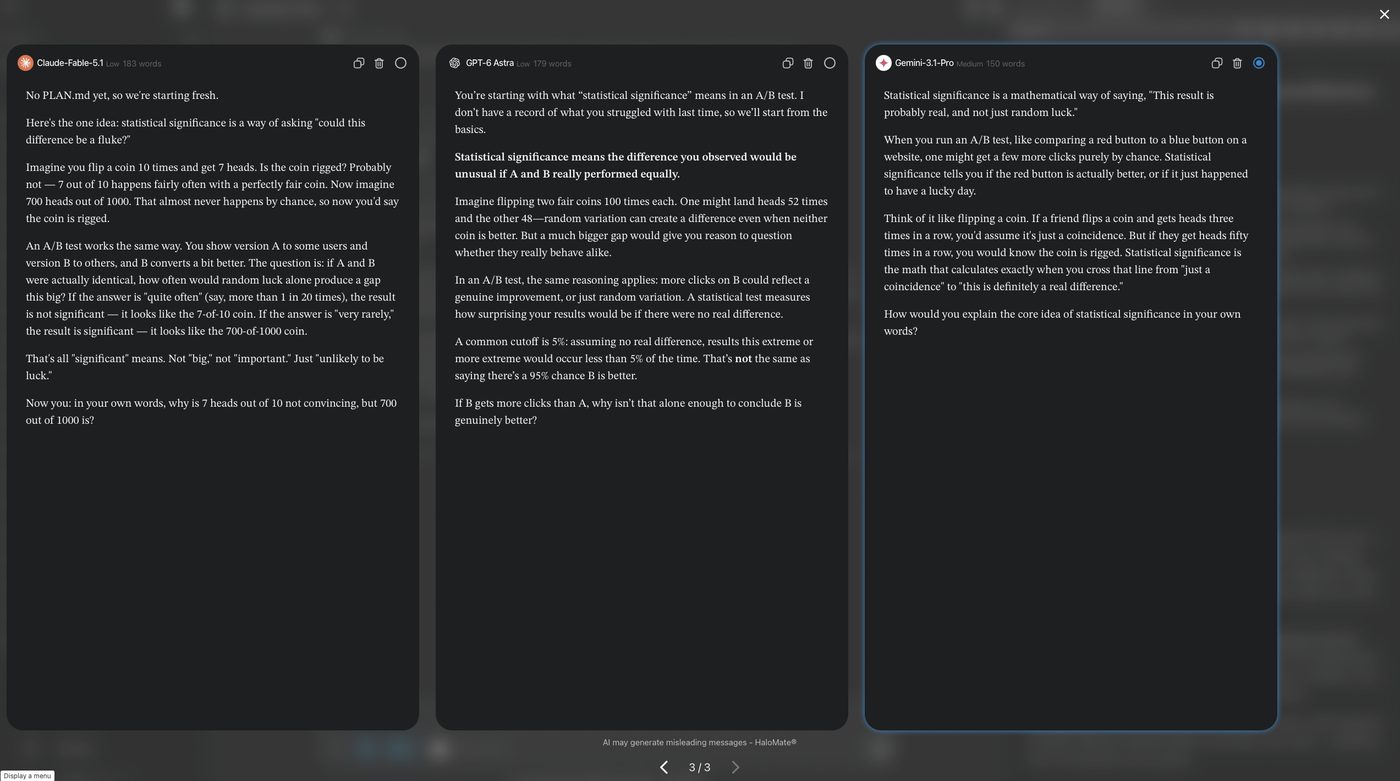
If you're an expert, the thorough ones are arguably better. They're more complete. But I'm not an expert, that's the entire reason I'm asking, and completeness is exactly what drowns a beginner. The GPT family in particular has a habit of covering every angle so it can't be accused of missing one. For research that's a feature. For a first lesson it's a firehose.
So: a teacher with amnesia, who also over-explains. No wonder we never finished anything.
The fix is embarrassingly low-tech: put the plan in a file
The insight that changed how I do this came from watching people who use AI to write code, which I do not.
Developers figured out a while ago that the chat window is a terrible place to keep state. So they keep a plan.md or CLAUDE.md in the project folder, and the AI reads it at the start of every session and updates it at the end. Anthropic wrote up the general pattern as "structured note-taking" for agents: the model writes its notes to a file outside its own context window, so the notes survive when the conversation doesn't. Hannah Stulberg has a good non-coder's guide to context files, and Eva Keiffenheim wrote about using Claude Code this way for lifelong learning, though both of those assume you're comfortable in a terminal, which I am not.
The principle underneath is simple enough to steal, though. Memory belongs in a file, not in a chat.
Chats expire, get too long, go bad. Files are persistent, editable, and both of you can read them. If the AI keeps a learning plan in a file, then every new conversation starts by reading where you are, and ends by writing down where you got to. The tutor no longer needs to remember anything. It just needs to be able to read.
I've started calling this the PLAN.md method, mostly because I needed something to call it.
The PLAN.md method, with the subject I'm actually learning
I picked something I've been faking at work for years: the statistics behind A/B testing. I'm a product manager. I approve experiments, I read dashboards that say "significant", and I have nodded through more than one meeting where someone said "the power isn't there". It was time.
Here's the setup, in four steps.
1. Build the project, and tell the AI its job includes bookkeeping
I made a project (a folder with standing instructions that every chat inside it can see) and wrote the goal in the instructions, roughly:
I'm learning the statistics behind A/B testing, from zero. You maintain a file called PLAN.md in this project. It holds the learning path, what I've finished, what I got wrong, and what to do next. Read it at the start of every conversation. Update it at the end of every conversation. Teach one chapter per conversation, and don't move on until I can explain the idea back to you in my own words.
That last sentence, about explaining it back, does more work than everything else combined. It's what stops the AI from lecturing, and it's what stops me from nodding along.
2. First conversation: plan, don't learn
The first chat is not a lesson. It's a planning meeting. We argued about what a reasonable path looked like for someone who can't remember what a standard deviation is, and it produced a first draft that was, predictably, way too ambitious. Twelve chapters, Bayesian methods by chapter eight. I told it I have maybe forty minutes a week and I would like to still be doing this in a month. We cut it to ten.
It wrote that to PLAN.md. That was the whole session, and it was the most useful forty minutes of the project.
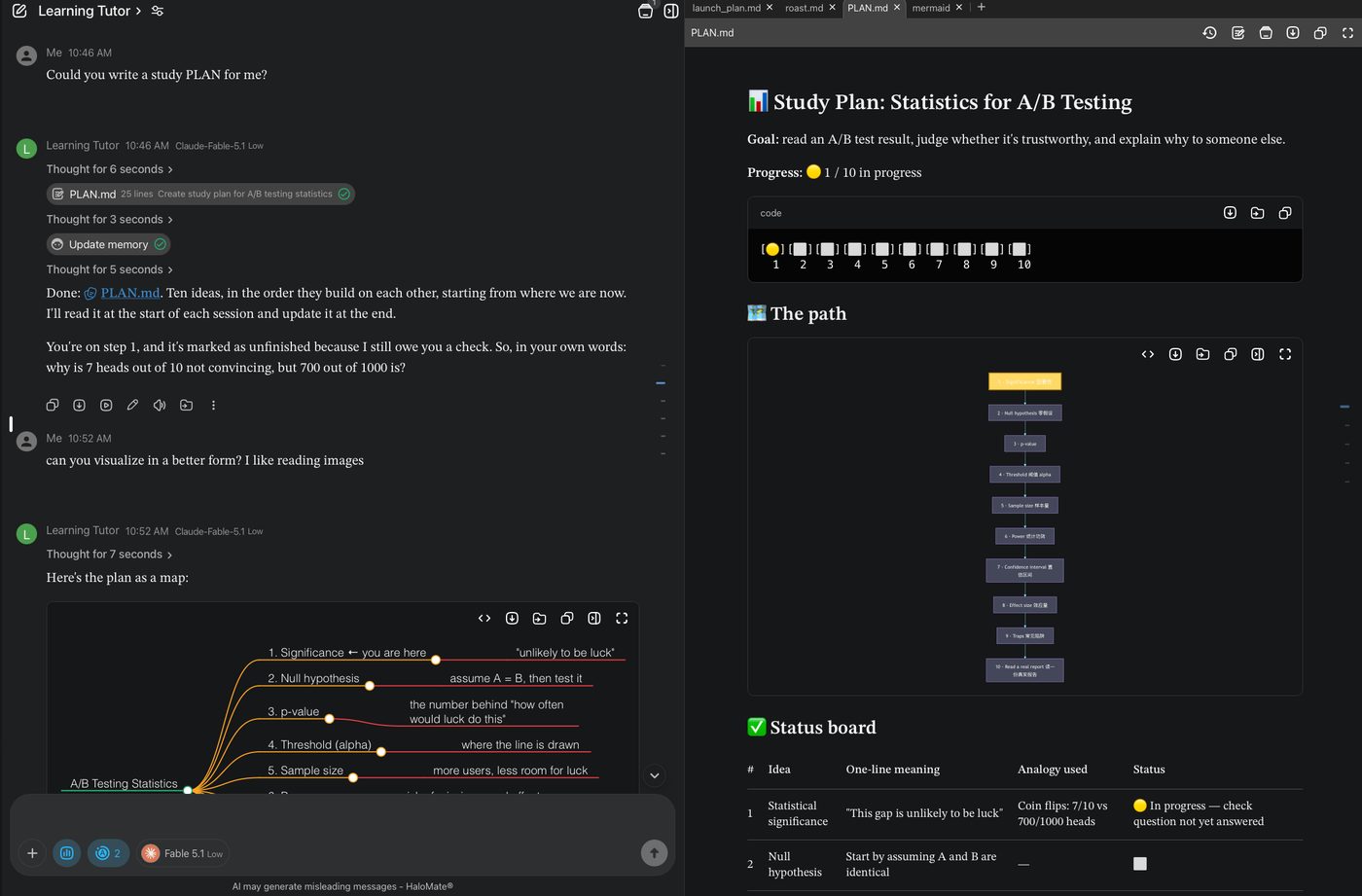
One caveat I learned the hard way: the plan you write on day one is a guess. After chapter one it was obvious my "zero" was lower than I'd claimed, so we went back and slid a chapter on basic probability in front of everything else. That's fine. The file is meant to be edited, and a plan that never changes usually means nobody's reading it.
3. Each chapter gets a fresh conversation
This is the part that felt wrong at first and turned out to be the point. Every step, I open a new chat. No scrolling back through last week. The AI reads PLAN.md, sees where I left off, sees that we never finished the check question last time, and picks up right there.
At the end, I ask it to update the file. It marks the chapter done, writes one line about what I struggled with, and notes what to open with next time.
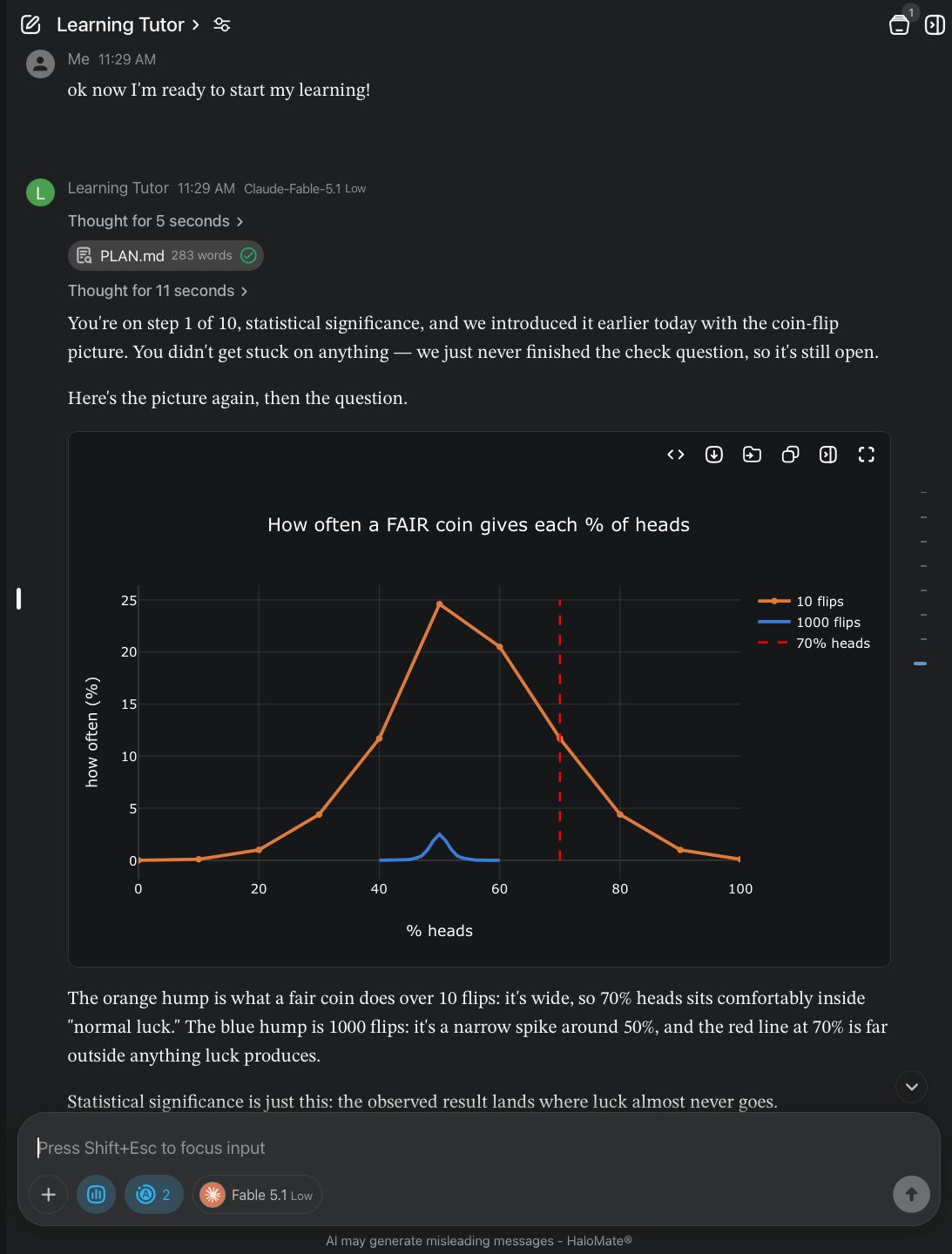
There is something slightly humbling about a text file keeping track of your mistakes with more discipline than you keep track of anything in your life. I've made peace with it.
4. Let the folder get thick
Notes go into the project as files. When I asked for a worked example and it was good, I had it saved as chapter-3-worked-example.md. Articles and a couple of PDFs I was reading on the side went into a reference/ folder, so the tutor could point at them instead of me pasting them in every time. A month in, the project is heavier than any single chat could be, and that weight is exactly the thing a chat can't hold.
This is the same reason I stopped exporting AI output into docs first. The living workspace is the course. Export is the handoff later, not the default memory.
Pick a teacher who talks like a person
One more thing I didn't expect to matter as much as it did.
The best teacher isn't the smartest model. It's the one that explains things in a way you can follow, listens when you say "I don't get it", and doesn't insist on the version of the explanation that didn't work the first time. For this particular project I ended up teaching with Gemini and, to my surprise, Grok, because both of them were happy to give me one idea at a time and ask a question back. When I wanted a rigorous second opinion on something I'd written in my own words, I'd run it past Claude or GPT and let them be picky. That's what they're good at.
Because the plan lives in the file and not in any one model's head, changing teachers costs nothing. The syllabus and my progress stay exactly where they were. I'm just swapping who's standing at the whiteboard. If your tool lets you switch models mid-project, this is one of the few places where I think that actually matters for a normal person, rather than being a spec-sheet feature.
What I'm using, and two things that only became possible once the plan was in a file
For the record: I did this in HaloMate, which has projects with files and lets me change the model per conversation. But nothing above requires it. Any tool where the AI can read and write a file inside a persistent folder will do, including ChatGPT Projects if you're willing to skip study mode and write the tutoring instructions yourself, which is more or less what the HN commenters ended up suggesting anyway.
Two follow-up questions came up once the basic method was working, and they're worth a paragraph each.
"Do I have to re-explain how I want to be taught every time?" For the first two weeks, yes, and it got old. The fix was to stop treating the tutor as a fresh model with a prompt and start treating it as a persona with its own long memory: a fixed teaching style, a preference for short explanations and check-back questions, and a running memory of which examples work on me and which don't. In HaloMate that's a Mate; in other tools it might be a custom assistant or a Gem. Whatever it's called, the point is that the teacher itself compounds. Chapter eight is taught by something that has learned how I learn, not by the model I happened to pick that morning. (I wrote the longer version of this as an employee handbook for an AI team. Same idea: role and residue travel; the engine is replaceable.)
"I understand it now, but can I actually use it?" Understanding a concept and being able to explain it to someone else are different skills. So at the end of the first step I asked the tutor to turn what we'd covered into a one-page cheat sheet: the chart, the key takeaway, the common traps, and a blank for me to write the idea in my own words. It generated the whole thing in the same conversation, and the cheat sheet has since been photographed by two colleagues who did not ask me to explain it, which I choose to take as a compliment.
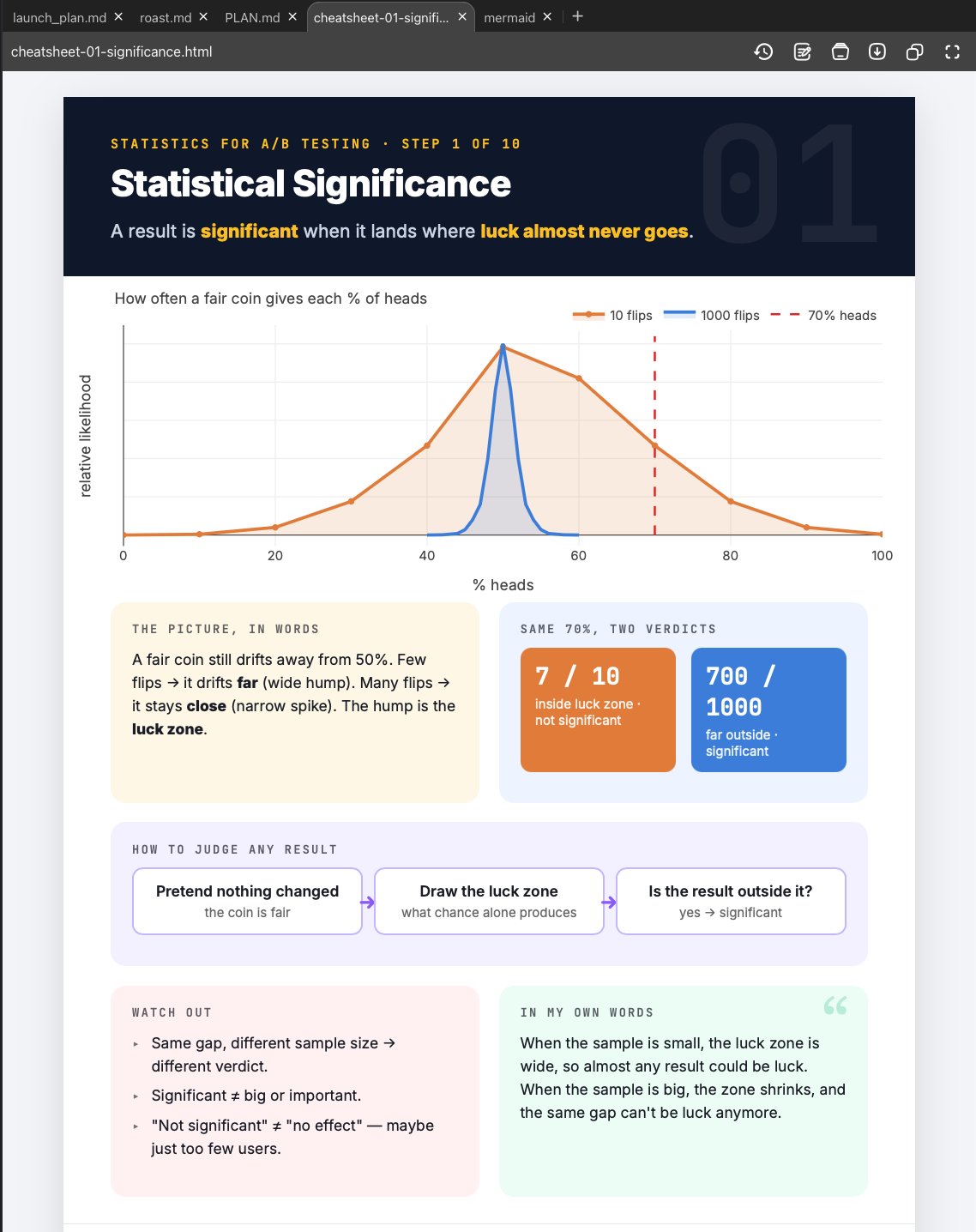
Learning something and being able to do something with it used to be two separate projects for me. Having the tutor and the calculator in the same room closed that gap faster than I expected.
Where this leaves study mode
I still think @study is a nice thing to have for a single homework problem. I just don't think a mode can fix what is really a filing problem. A tutor that can't see last week is a tutor for people who only need one session, and most things worth learning take more than one.
I'm on step six of ten. The weak-spots section of PLAN.md is longer than I would like. But for the first time in three years of asking AI to teach me things, I can tell you exactly where I am in the course, and so can it.
It's just a file. It turns out that was the missing piece.