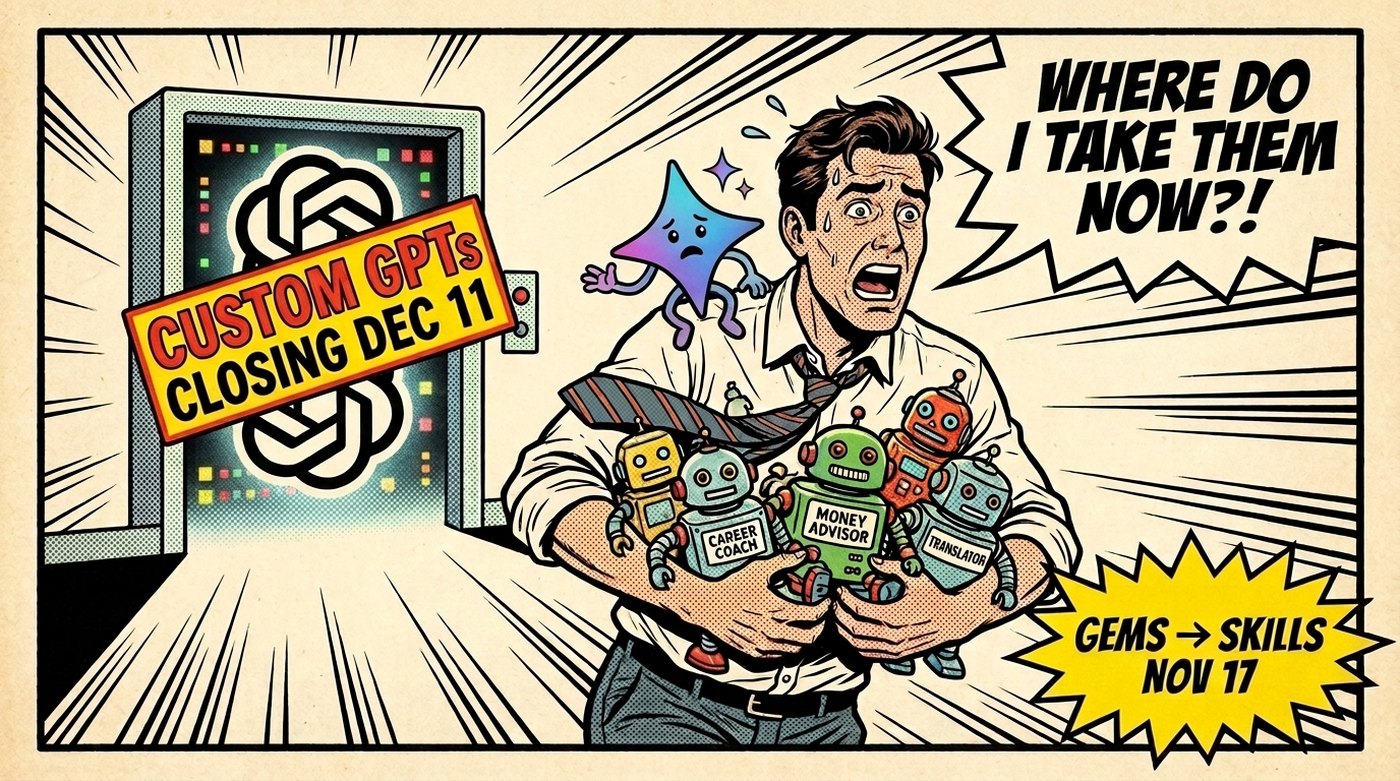
In the same stretch of 2026, OpenAI put Custom GPTs on a retirement clock (hard date on the FAQ: Dec 11, 2026) and Google started turning Gemini Gems into Skills (app transition window around Nov 17). The help-center language is calm. The OpenAI forum threads and r/ChatGPT posts are not. Same energy on the Gemini side: TechCrunch, 9to5Google, and a pile of “what does this mean practically” threads in r/GeminiAI.
What I keep reading is not nostalgia for the GPT Store. It is people trying to name a job the replacement stack only half covers. A Custom GPT, used well, was a door you opened on purpose. New chat, same instructions, same files if you attached them, and, critically for a lot of us, a boundary that did not automatically drink from your whole-account memory. ChatGPT Projects are excellent at the opposite job: continuity. Threads inside a Project are supposed to influence each other. That is a feature when you are mid-draft on a real workstream. It is the wrong architecture when you wanted a reusable room that starts clean.
Skills and plugins pull another direction again. Per OpenAI’s own migration FAQ, a skill lives inside whatever conversation invoked it; a migrated plugin can carry instructions and reference files; behavior may change; Custom Actions do not simply come along for the ride. Google’s Gems → skills note rhymes with that shift: less “I open this Gem,” more “the model may apply this skill when it thinks the intent matches.” Some people want exactly that. Others built Gems so a Japanese-translation room and a bill-formatting room stayed one intentional click away, not a hopeful auto-select.
I will share what I settled on later, including the failed attempts. That is not the point of this piece. The point is the job map: most people are not missing a brand, they are missing a clean name for what the GPT or Gem was actually doing. My setup only covers one row. Large chunks of the map still point somewhere else on purpose.
The map I wish I’d had week one
I am in the intentional-room camp for a boring personal reason. I did not collect GPTs because I liked the mall. I kept separate personas. One career coach. One therapist-shaped sounding board. One financial advisor. I do not want my promotion prep casually soaked in a 2am spiral, and I do not want money stress sitting in the same long-term bucket as performance-review language unless I choose to carry it over. That is not a universal morality tale. It is one concrete version of the same boundary problem the long threads keep circling: controlled context is not the same product as cumulative context.
Before the long list, here is the preview I redraw every time someone asks “so what do I switch to?” Read it left to right: what you needed → better place → common mismatch.
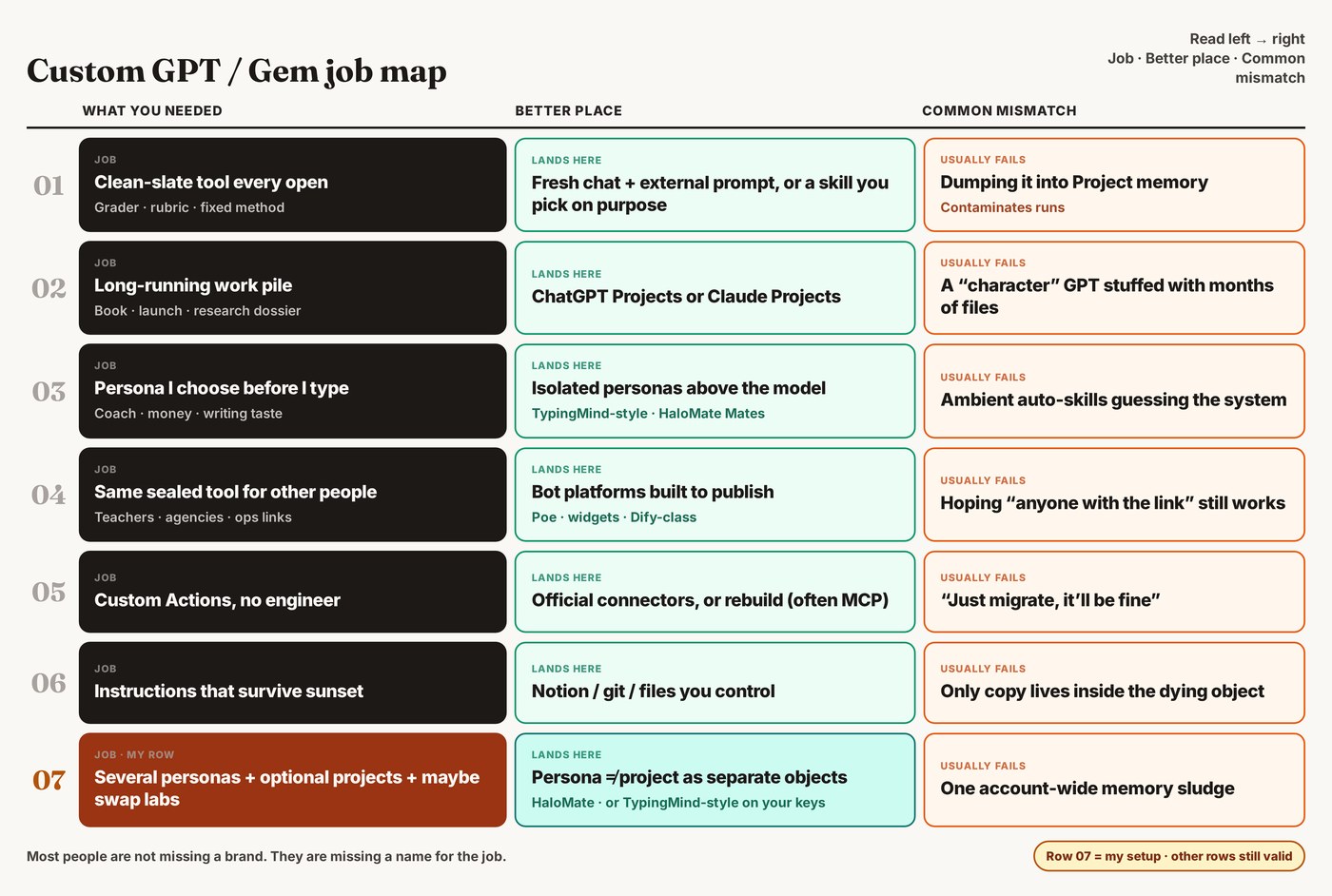
That map is the article. Everything below is receipts and packing notes. Product names that matter for the “better place” column still get plain links in the sections: ChatGPT Projects, Claude Projects, TypingMind, HaloMate, Poe, Dify.
Persona is not project
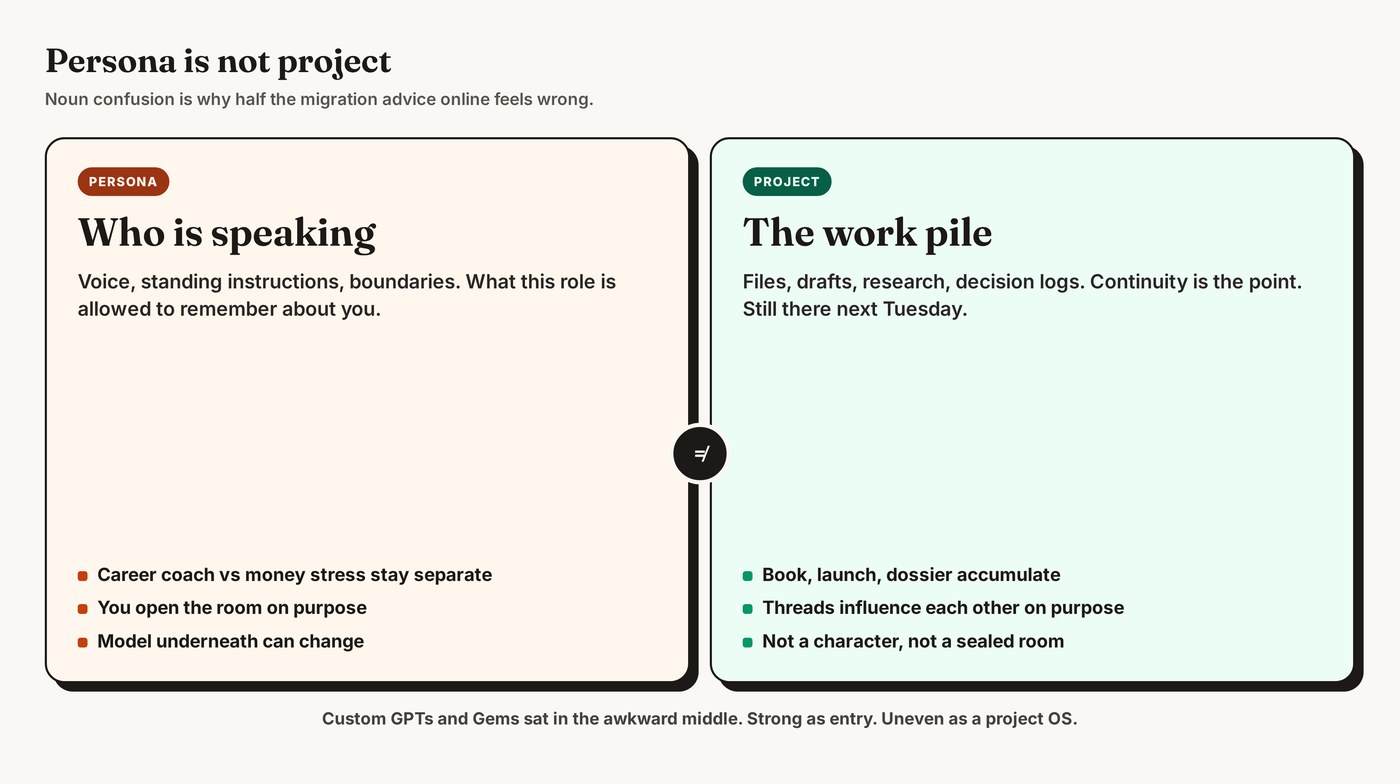
Persona is who is speaking, and what they are allowed to remember about you in that role. Voice. Standing instructions. Boundaries. The slow build of “this is how I talk to my career coach” versus “this is how I talk when I am scared about money.”
Project is the work pile. Files, drafts, research, decision logs, the messy arc that should still be there next Tuesday. Continuity is the point.
A lot of bad migrations are noun confusion:
- Stuffing three life roles into one account-wide memory and hoping the model “keeps it straight.”
- Using a single Claude or ChatGPT Project as a fake persona, so every file chat bleeds tone and facts into the next.
- Using a Custom GPT as a dumping ground for a three-month initiative when what you actually needed was project continuity, not a character.
Custom GPTs and Gems sat in the awkward middle. They were strong as persona-shaped entry: you chose the room, then you spoke. They were inconsistent as a long-running project OS, depending on how hard you leaned on knowledge files and whether you treated each open as a clean tool or a continuing relationship.
Once you separate the nouns, the retirement advice online gets easier to sort. “Just use Projects” is correct when your job was cumulative work. It is almost exactly wrong when your job was a role you walk into with a hard boundary. “Just use Skills” is correct when you want capabilities layered onto a general chat. It is a downgrade when the whole point was not letting the general chat run the show.
Where people actually go
Grouped by the job you had, not by who shouts loudest in SEO.
1. Reusable tool, clean slate every open
Doc graders. Rubric checkers. “Analyze this with the same method, ignore my chat history.”
Where people point you: migrate instructions into a ChatGPT plugin skill per the retirement FAQ; or keep the prompt outside the app and paste it into a fresh chat; some rebuild the same idea inside a coding agent.
What still breaks: you lose the dedicated front door. Official migration says plugins may respond differently. Knowledge files can hit new limits. This was never what Projects were for, and forcing it into Project memory is how you get contaminated runs. The “not an equivalent migration” threads are full of people who learned that the hard way.
2. Long-running work where memory is a feature
A book. A product launch. A research dossier that should accumulate.
Where people point you: ChatGPT Projects or Claude Projects. This is the honest home for that job.
What still breaks: nothing “breaks” if this is what you wanted. What breaks is pretending this replaces a persona room. Shared projects also tend toward collaborative workspace behavior, not “ship the same sealed tool to twenty people who never see the guts.”
3. A persona I choose before I type
Career coach. Therapist-shaped board. Financial advisor. Writing partner with a fixed taste. The Gem users who freaked out about auto Skills were often here: they did not want a generalist guessing which system to load. (r/GeminiAI is basically that argument on loop.)
Where people point you:
- Stay on OpenAI and approximate with plugin skills or carefully isolated Projects (awkward).
- Move the persona instructions into Claude Projects or Claude Skills.
- Use a multi-assistant frontend so the “who” lives above any one lab (TypingMind-style agents; HaloMate if you also want a real project pile next to the persona).
- Rebuild as Gemini Skills if you accept intent-based invocation instead of walk-in selection (Google’s transition page).
What still breaks: ambient invocation changes the power dynamic. You are negotiating with a router, not opening a door. Multi-lab setups fix lock-in and create sync chores. Whatever you pick, export the persona text now. The week of the sunset is a bad time to discover your best instructions only lived inside a dead object.
4. Same assistant for other people, instructions stay private
Teachers, small agencies, internal ops tools, “here is the link, it always behaves like this.”
Where people point you: plugin sharing and review flows on OpenAI’s side; or leave the consumer GPT world entirely for bot platforms built to publish (Poe, site chat widgets, open-source stacks like Dify or Botpress, commercial builders aimed at selling access).
What still breaks: “anyone with the link” as a casual distribution model is largely gone in the OpenAI path. The access-concern threads are blunt about it. Migrated plugins default private. If distribution was the product, you are not doing a settings tweak. You are changing business packaging.
5. Custom Actions without becoming an engineer
Where people point you: official connectors where they exist; otherwise MCP servers and rebuilds.
What still breaks: the old GPT builder virtue was approachable wiring. “Rebuild it as MCP” is sensible engineering advice and a lousy emotional substitute for people who shipped real workflows without a software job. Start these migrations first. They are the ones that do not fit in an afternoon of copy-paste. OpenAI is explicit in the FAQ that Actions do not simply ride along.
6. Instructions that survive the next sunset
This is the PromptEngineering thread energy: keep a copy somewhere the vendor cannot rebrand into oblivion.
Where people point you: Notion or a git repo as source of truth; agent UIs that load system prompts from files; shared-memory experiments some power users run across Claude, Cursor, Codex, and friends.
What still breaks: sync is a chore you will skip on bad weeks. Models are lazy about writing durable memory unless you nag them. External storage fixes lock-in. It does not fix discipline.
7. Several long-lived personas, optional projects, and I might change models
This is my actual job mix. Three roles that should not share a brain. Sometimes a real document pile. Sometimes I want a second opinion from a different lab without rebuilding the person.
Where people point you: pay for two labs and duplicate personas; TypingMind-style agents on your own keys; workspaces that keep persona and project as separate objects (HaloMate is the one I ended on).
I landed somewhere boring after two failed attempts.
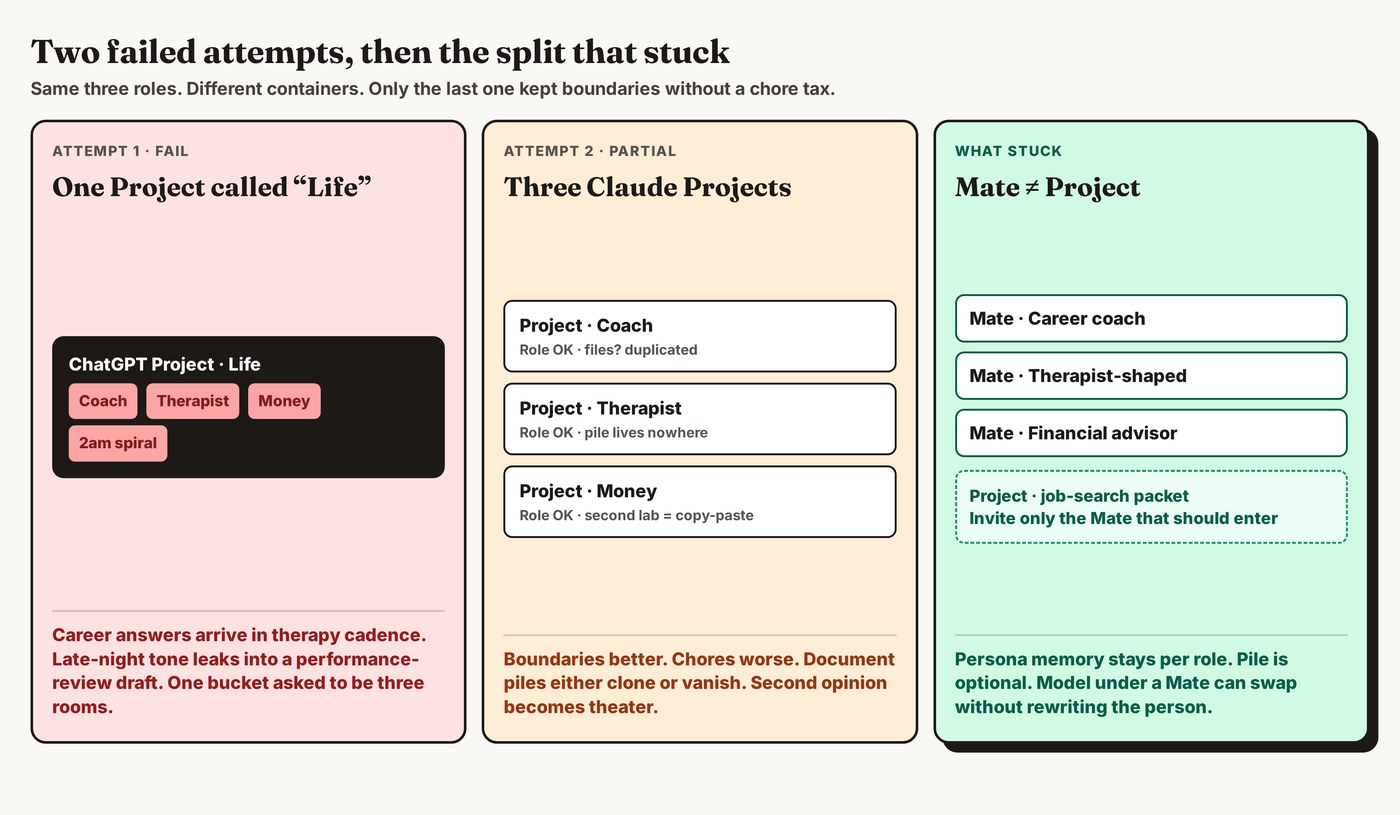
First I tried “one ChatGPT Project called Life” and pasted all three system prompts into the project instructions. For a week it felt tidy. Then the career coach started answering money questions in therapy cadence, and a late-night spiral showed up as tone in a performance-review draft. Not a model bug. I had asked one bucket to be three rooms.
Second attempt: three carefully named Claude Projects, one role each. Better boundaries. Worse chores. Any real document pile (job-search packet, tax folder) either got duplicated or lived nowhere, and when I wanted Claude’s draft and a second pass from another lab I was back to copy-paste theater.
What stuck is treating the nouns as separate objects in HaloMate: a Mate holds the persona (instructions plus memory for that role only), a Project holds the pile when there is one. Career coach, therapist-shaped board, and financial advisor are three Mates. They do not inherit each other’s late-night spiral by default. When I have a real arc, I drop files into a Project and invite the Mate that should enter that room. I do not merge all three lives into one assistant and pray. The model under a Mate is swappable. The persona is not rewritten every time a lab ships a new default brain.
That split sounds obvious after you say it out loud. Most consumer UIs still make you fake it with one memory sludge or one Project pretending to be a character. TypingMind-class agents get you a long way on the “who” axis if you already run your own keys. Projects inside a single lab get you a long way on the “pile” axis. I wanted both without keeping three parallel file trees.
Honest limits on my setup too: it is still software on someone else’s computer. I still keep exports of the important instructions. If your whole world is OpenAI’s apps and your users already live in ChatGPT, the plugin path is less ideological drama than following me. If you live in Docs and Sheets, Gemini Skills are the path of least friction (Workspace update). If you only need one writing lab and you like Claude, a Claude Project may be enough and you should not invent a multi-tool religion. If you are trying to sell a branded bot, you want the commercial builders in section 4, not a personal persona workspace.
8. Google Workspace native / single-lab depth / “I am done with Gems anyway”
Not everyone is grieving. Gemini threads are full of people who found Gems slow, buried in menus, or oddly amnesiac mid-chat. For them Skills are a cleanup (Google’s own framing). For NotebookLM-centered workflows, the center of gravity was already elsewhere.
Where people point you: Skills; NotebookLM; Claude if you wanted project scoping all along.
What still breaks: regional rollout and “I never got Spark” complaints are real. Auto-migration is not the same as loving the new verb.
A simple packing list
Do this before the freezes matter more than your mood. Dates to watch: Gemini Gems → skills around Nov 17, 2026; Custom GPT retirement on Dec 11, 2026 (Enterprise exceptions live on the FAQ, not on Twitter rumors).
- Copy every persona’s instructions into a plain doc you control.
- Download knowledge files. Note anything that fails size checks on the way out.
- List Actions and what they touched. Those are rebuilds, not migrations.
- Label each GPT/Gem you own as persona, clean tool, or project impostor. The label decides the destination.
- Decide distribution: private life tool vs something other humans open by link.
- Only then click official migrate, or rebuild elsewhere.
Short answers to the arguments in my replies
“Plugins will be better.”
Maybe. “Can be reconstructed across Skills, Projects, Plugins, and MCP” is not the same sentence as “what I already built still exists.” Test before the old door locks. Start from the official FAQ, then read the people who already migrated.
“Projects are the replacement.”
For cumulative work, yes. For a career coach who should not inherit therapy context, no.
“Skills are Gems with better UX.”
Sometimes. If you wanted multi-skill in one chat, you may prefer it. If you wanted a sealed room you enter on purpose, you will feel the difference the first week. Google’s transition copy is honest about the verb change; the forums are honest about the feeling change.
“Just pick Claude.”
Fine for many writers. You still have to decide whether each Claude Project is a persona, a dossier, or an accidental mashup of both.
What I am optimizing for after packing
Not a perfect eternal app. A clearer vocabulary.
- Personas stay separate when the roles should stay separate.
- Projects hold piles, not identities.
- Instructions have a copy outside the thing that can be renamed in a release note.
- Models are engines. They are allowed to change under a persona without a full identity migration.
Custom GPTs and Gems made the first bullet easy enough that millions of people built rooms without calling them personas. The 2026 retirements do not erase the job. They just stop pretending one vendor feature was a forever lease.
Map the job first. Then pick the row. And keep a box you can carry when the next noun change arrives.