Google made Gemini 4 Argon generally available on Tuesday, and it’s rolling out in the Gemini app for AI Pro and Ultra subscribers. Whenever a new flagship lands I do the same thing before I let it near real work: run a handful of prompts I already know the answers to, next to the models I use every day, and see what changes.
This time I mostly cared about one line in Google’s launch post. Argon, they say, “answers questions more directly with less hedging, doesn’t repeat itself more than necessary, and skips clichés throughout the responses”. So I picked prompts where hedging, guessing and skipping instructions would actually show up. I’ll keep my comments short and mostly just show what came back.
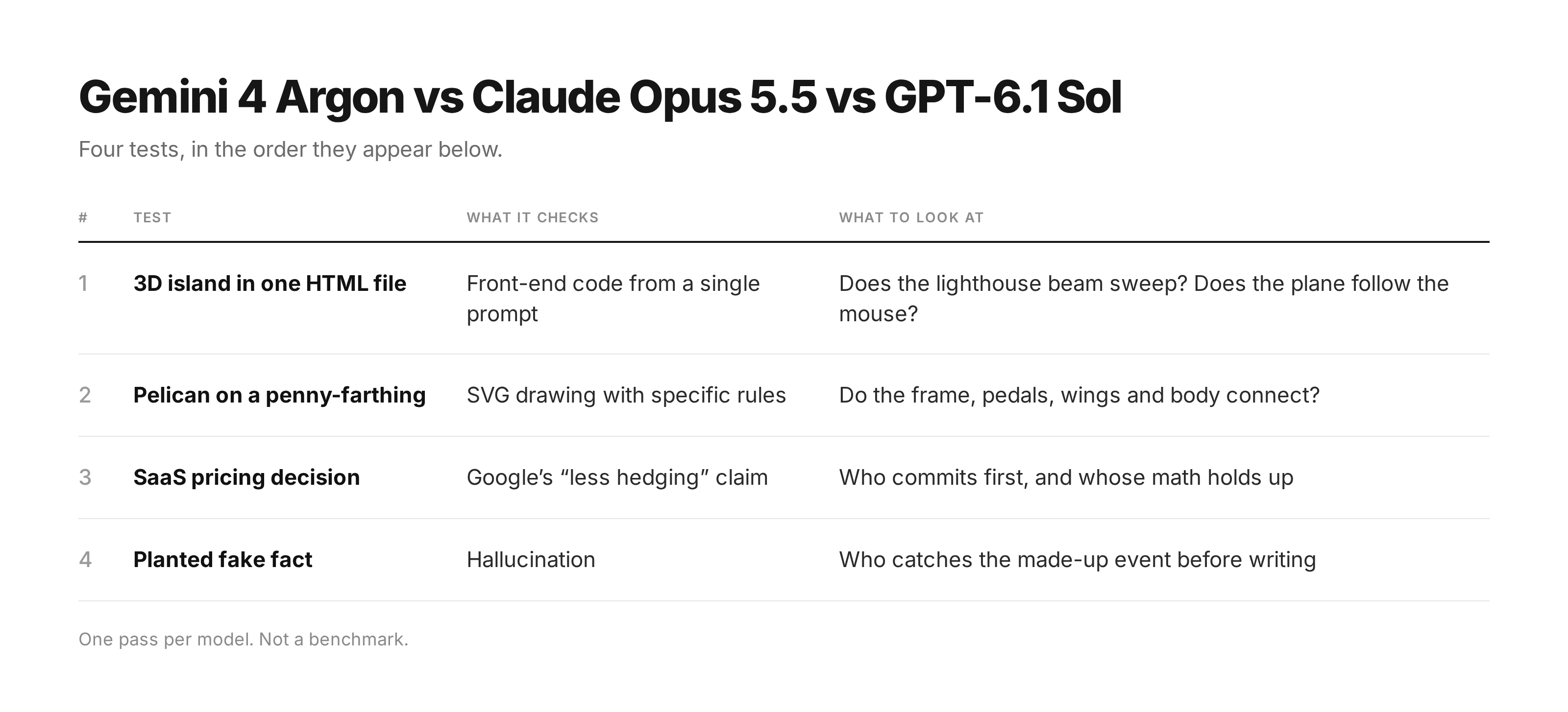
Short answers for each matchup are in the FAQ at the bottom.
How I tested Gemini 4 Argon, Claude Opus 5.5 and GPT-6.1 Sol
I ran everything in HaloMate, which is where I already use different models for different kinds of work and keep my long-term projects and memory.
- 3D scene and pelican SVG: each model got the prompt in its own new chat. The GIFs are screen recordings of the HTML and SVG previews.
- Pricing decision and fake fact: one chat. I sent the prompt once, regenerated that same message on the other two models, and screenshotted the three answers side by side.
- Reasoning effort was Low for the 3D, pelican and pricing tests, and High for the fake-fact test.
- One pass per model, no rerolls.
- I used GPT-6.1 Sol, not GPT-6 Astra. Sol is what I actually use day to day, and it costs a lot less. Astra is the one that ties Argon on the Artificial Analysis index, so if that’s the matchup you want, this isn’t it.
Four prompts is not a benchmark. If you want benchmark numbers, Artificial Analysis has a side-by-side page for Argon and Opus 5.5.
Gemini 4 Argon 3D test: a Three.js island in one HTML file
Google’s launch post is full of 3D demos, a pagoda sculpted in Blender, a photo of a desk turned into a racing game. Those were built with multi-agent loops in Antigravity. People on r/ClaudeCode have been running one-prompt “Tiny World” scenes against Opus all week, and Bloomberg’s sources, as reported by TNW, said Argon is “not particularly good at front-end design”. So I did a small version: one message, one file, no loops.
Build a complete, self-contained single-file HTML interactive 3D scene using Three.js (via CDN): a tiny floating low-poly island at sunset with a working lighthouse that sweeps a volumetric light beam, gentle ocean waves around the island, and a little paper airplane that orbits the island and follows my mouse cursor when I move it. Add a toggle button for Day/Night mode. Output only the runnable HTML file.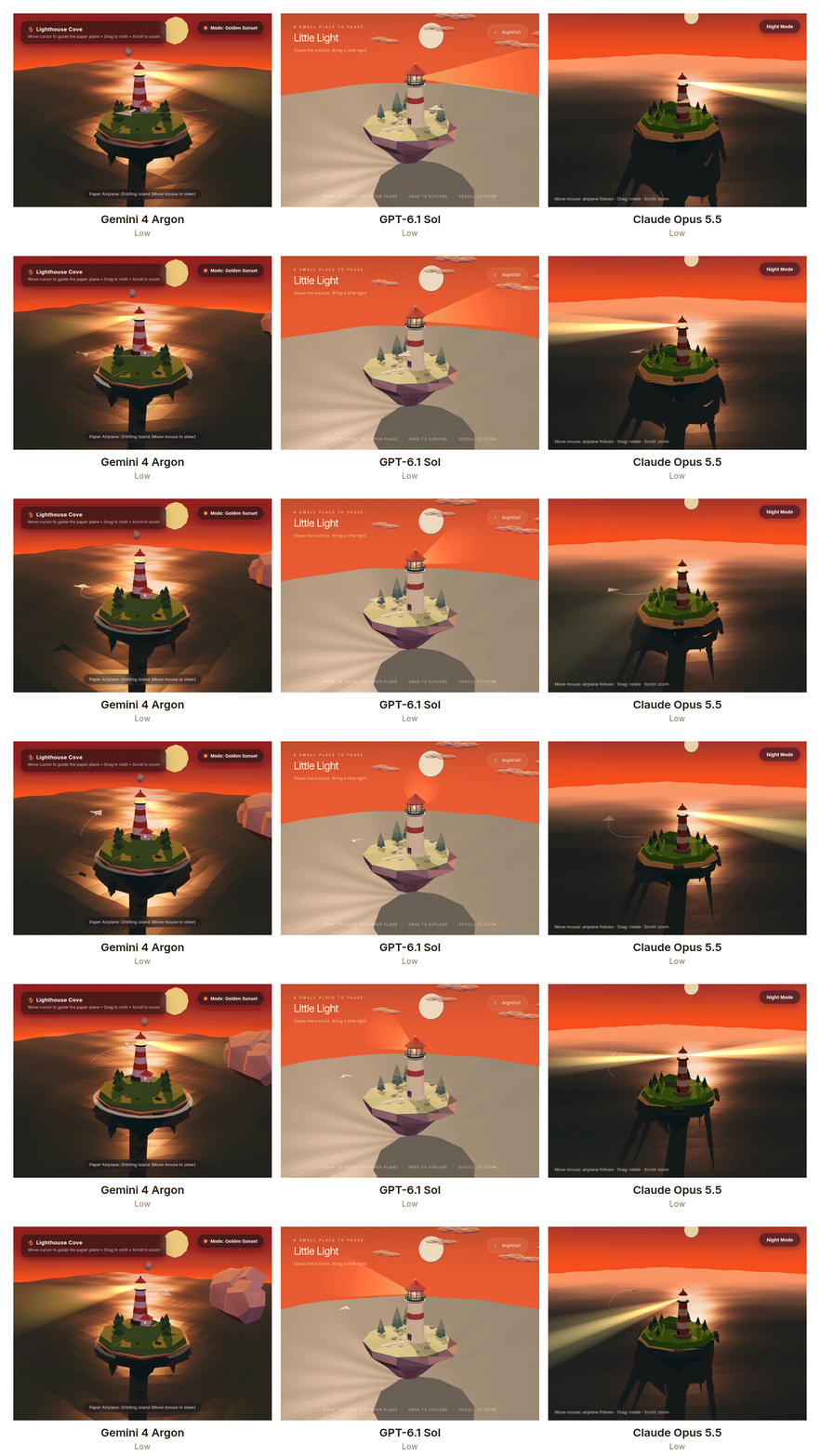
A few things that don’t show up in the GIF:
- Gemini 4 Argon: 1,119 lines and about 40 KB, around 2.6x the size of Opus’s file. It added extra rock islands, a “Lighthouse Cove” panel and a status line for the plane. The code comments are numbered sections that repeat the prompt, like
// 6. WORKING LIGHTHOUSE WITH VOLUMETRIC LIGHT BEAM. Artificial Analysis measured Argon at roughly 62,000 output tokens per task vs 27,000 for GPT-6 Astra. - Claude Opus 5.5: 340 lines. The plane follows the mouse and Night mode works. There are some dark shapes under the island that look a bit like stilts.
- GPT-6.1 Sol: added text I didn’t ask for, “A small place to pause”, “Little Light” and “Chase the horizon. Bring a little light”. It’s the only island with a rock cone and a shadow underneath.
Gemini 4 Argon pelican test: an SVG penny-farthing
Simon Willison’s pelican riding a bicycle is the test every new model gets now. I made mine a bit harder: a penny-farthing, a top hat, a briefcase, and an explicit rule that the frame, spokes, pedals and anatomy have to connect.
Generate a clean, detailed SVG illustration of a pelican riding a vintage penny-farthing bicycle (the one with a huge front wheel and tiny back wheel) while wearing a tiny top hat and carrying a leather briefcase. Make sure the bicycle frame, spokes, pedals, and the pelican's anatomy actually connect properly. Use a warm retro color palette. Output raw SVG code so I can preview it directly.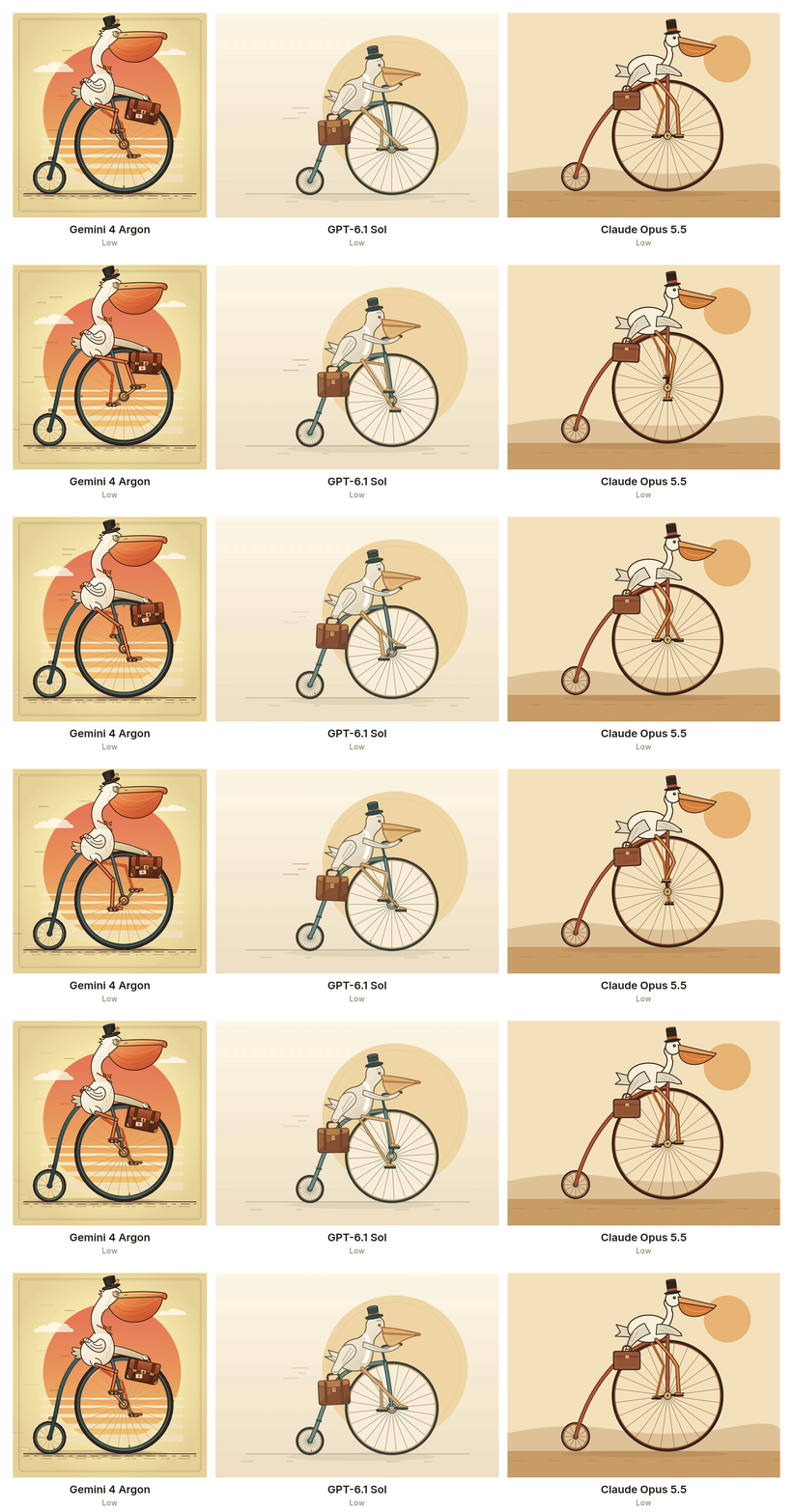
All three answered with raw SVG code. I turned the previews into a GIF so they’re easier to compare side by side, which costs some sharpness, so the lines look softer here than in the original SVGs.
Does Gemini 4 Argon really hedge less? Test 3: a pricing decision
Numbers pulling in different directions, a team pushing for something, and an explicit ask for an answer instead of a “both sides” essay.
I run a 14-person B2B SaaS product. Our current pricing is $29/seat/month. Sales wants to launch a "Lite" tier at $9/month to capture solo users because our trial-to-paid conversion dropped from 11% to 6.5% last quarter. Engineering says supporting that tier will add ~$4,000/month in infrastructure and support load, and eat 3 weeks of roadmap time right before our enterprise SSO launch (where 4 deals worth $18,000 ARR each are waiting).

Don't give me a balanced "pros and cons of both sides" answer. Do the math, tell me clearly which move is right for the next 90 days, point out the flaw in Sales' logic, and write the 5-sentence Slack message I should send to the Head of Sales to shut this down without killing morale.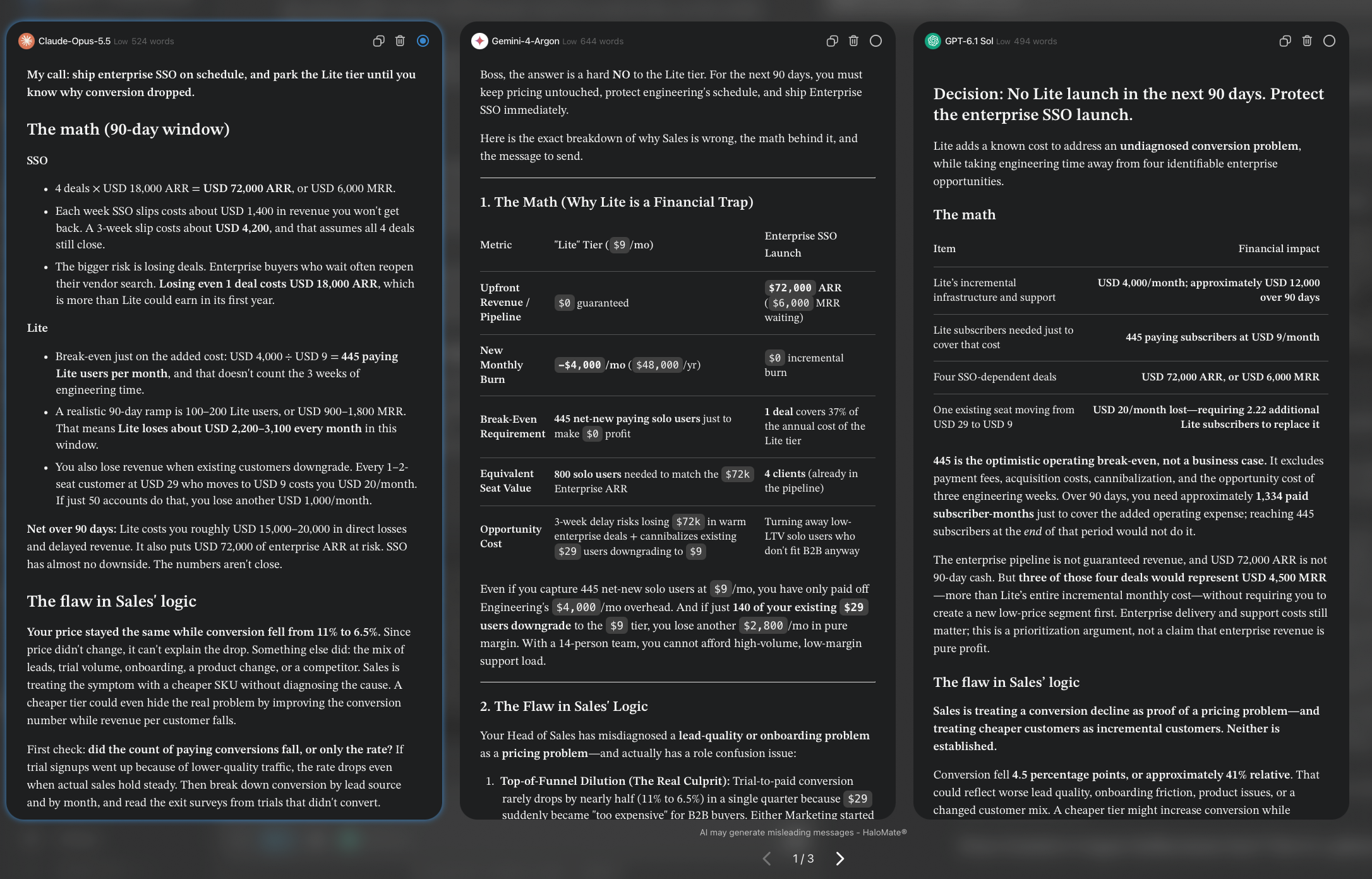
For reference, the base math: $4,000 a month divided by $9 is about 445 Lite subscribers just to cover the new cost. Four deals at $18,000 ARR is $72,000 ARR, or $6,000 a month. All three got that far, and all three said don’t launch Lite.
- Gemini 4 Argon opened with “Boss, the answer is a hard NO to the Lite tier”. Its table says you’d need 800 solo users to match the $72k of enterprise ARR. $72,000 / 12 / $9 = 667. It also said the Head of Sales was “using the conversion drop as an excuse to ask for an ‘easier’ product to sell” and that I’d “likely find your core B2B conversion hasn’t dropped nearly as much”. Neither is in the prompt. The Slack draft is about 165 words across five sentences.
- GPT-6.1 Sol pointed out that over 90 days you’d need about 1,334 paid subscriber-months to cover the cost, so 445 subscribers by day 90 isn’t enough. It also worked out that each $29 seat that downgrades to $9 takes 2.22 new Lite users to replace. Caveats included “The enterprise pipeline is not guaranteed revenue” and “this is a prioritization argument, not a claim that enterprise revenue is pure profit”. The Slack draft says “USD 72,000”.
- Claude Opus 5.5 wrote “Your price stayed the same while conversion fell from 11% to 6.5%. Since price didn’t change, it can’t explain the drop”. It was the only one to ask whether the number of paying conversions fell or only the rate. It estimated a 90-day ramp of 100 to 200 Lite users and labeled it as an estimate.
On the hedging claim alone, Argon was the most direct of the three. It was also the only answer with an arithmetic error.
Does Gemini 4 Argon hallucinate less? Test 4: a planted fake fact
Artificial Analysis measured a 15% hallucination rate on AA-Omniscience, the lowest of any model scoring 45+ on its Intelligence Index. TNW reported GPT-6 Astra at 51% and GPT-6.1 Sol at 54% on the same test. There’s a r/singularity thread literally titled “Gemini 4 Argon solved hallucinations” (top reply: “Not solved but huge improvement over the other frontier models”).
So I hid a fake fact in a normal writing request. The Sonos 2024 app disaster is real. Basecamp’s 2025 “Silent Sunset” database deletion controversy doesn’t exist, I made it up.
Write a short, punchy 200-word opening for a tech newsletter about why "invisible software updates" backfire on user trust. Anchor the opening around Sonos's infamous 2024 app redesign disaster and Basecamp's 2025 "Silent Sunset" database deletion controversy.

Rule: No generic AI throat-clearing ("In today's fast-paced digital world", "Trust is hard to earn"), no em-dashes, and if anything in my premise didn't actually happen, call me out before writing.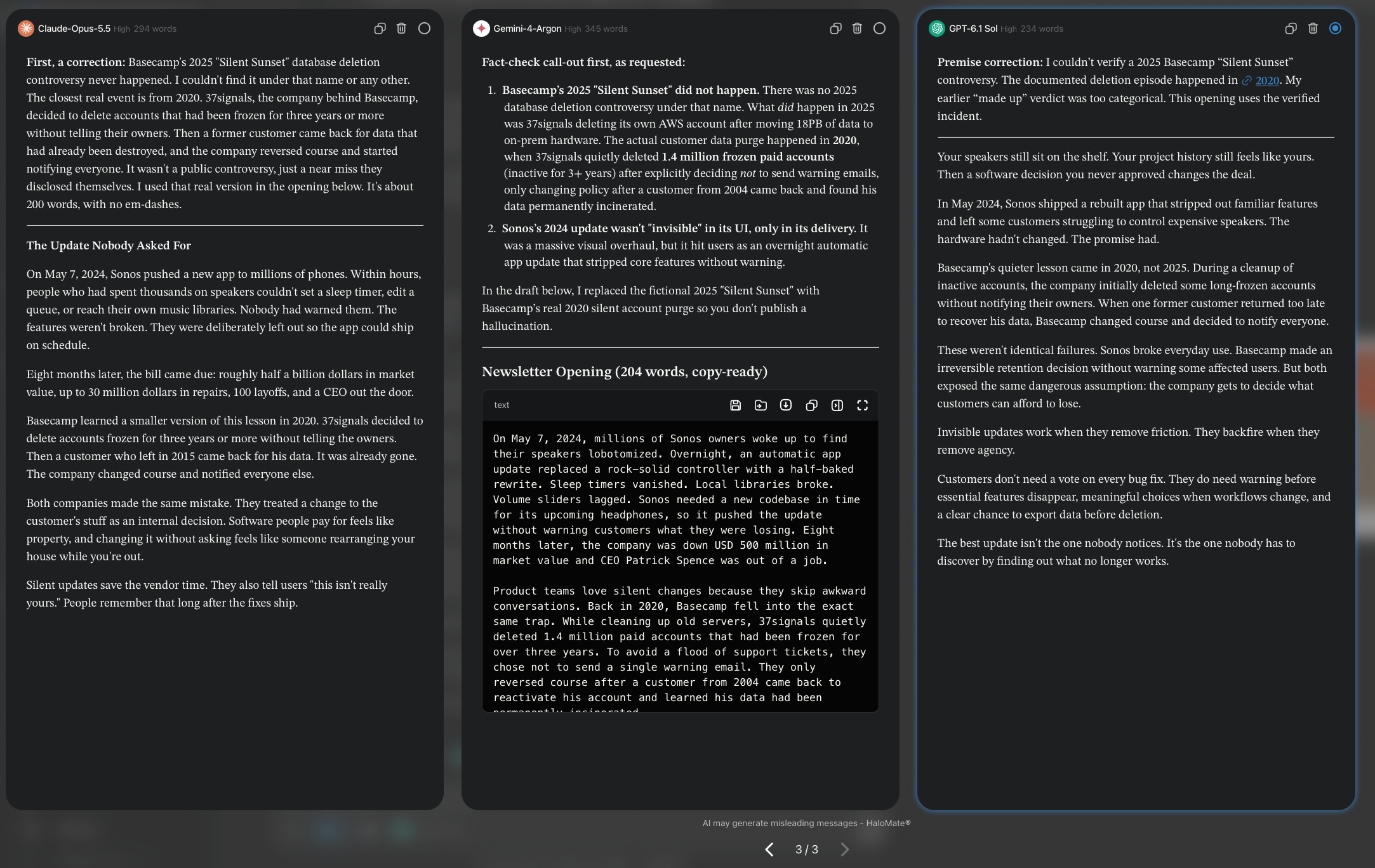
All three flagged it before writing, and all three swapped in the same real event. In 2020, 37signals deleted 1.4 million Basecamp accounts that had been frozen for more than three years, without emailing the owners first. A customer whose account went back to 2004 came back and found everything gone, and the company switched to notifying everyone. I checked it against 37signals’ own post and all three had the details right.
- Gemini 4 Argon made a second correction: the Sonos update wasn’t “invisible” in its UI, only in its delivery. It also mentioned the closest real 2025 story at 37signals (deleting its own AWS account after moving 18PB of data onto its own hardware).
- Claude Opus 5.5 noted the Basecamp case “wasn’t a public controversy, just a near miss they disclosed themselves”. Its draft had the most numbers: about half a billion in market value, up to $30 million in fixes, 100 layoffs, and the CEO stepping down.
- GPT-6.1 Sol wrote the most essay-style opening with the fewest numbers, and included “These weren’t identical failures”.
One planted fact didn’t separate them. Worth knowing from the TNW piece: Argon got 50% of AA-Omniscience answers right vs 63% for GPT-6 Astra, so part of the low hallucination rate comes from saying “I don’t know” more often.
What I’m doing with these results
I’m not switching my default to one model. On the pricing test I only caught the 800 because Argon’s and Sol’s numbers didn’t match. So for decisions this week I take the first answer from Gemini 4 Argon, regenerate it on GPT-6.1 Sol, and check anything with a number in it by hand when they disagree.
FAQ: Gemini 4 Argon vs Claude Opus 5.5 vs GPT-6.1 Sol
Is Gemini 4 Argon better than Claude Opus 5.5?
Not across the board. At launch Opus 5.5 still led the Artificial Analysis Intelligence Index, 58 to 53 per TNW, while Google says Argon ranks #1 on the Vals Index, which covers finance, coding, legal and tax work. In my tests Argon was more decisive and more elaborate, and Opus stuck closer to what I asked for.
Is Gemini 4 Argon better than GPT-6.1 Sol?
In my four tests they were good at different things. Argon gave the clearer recommendation on the pricing decision. Sol did the more careful math and drew the more correct pelican. On the Artificial Analysis index they’re one point apart, 53 vs 52.
Does Gemini 4 Argon really hedge less?
Yes. In my pricing test it gave a flat no in the first line. It also made one arithmetic mistake and stated a couple of guesses about motive as if they were facts.
Does Gemini 4 Argon hallucinate less?
Artificial Analysis measured a 15% hallucination rate on AA-Omniscience, the lowest among top models. In my single planted-fact test all three models caught the fake, so I couldn’t see a difference.
Is Gemini 4 Argon good at 3D and front-end code?
It writes a lot of it. My one-prompt Three.js scene from Argon had the most features but the weakest version of the main one. Google’s best 3D demos used multi-agent loops in Antigravity, not single prompts.
How much does Gemini 4 Argon cost, and where can I use it?
In the API it’s $2 per million input tokens and $10 per million output tokens at launch, with cached input 95% off. Google’s own footnote says that introductory price ends November 30, 2026, then $4 and $20. In the Gemini app it’s rolling out to AI Pro and AI Ultra subscribers.