If you landed here from Manus alternatives, Manus restore failed, Manus website down, or should I leave Manus, same week. Same problem under different search boxes.
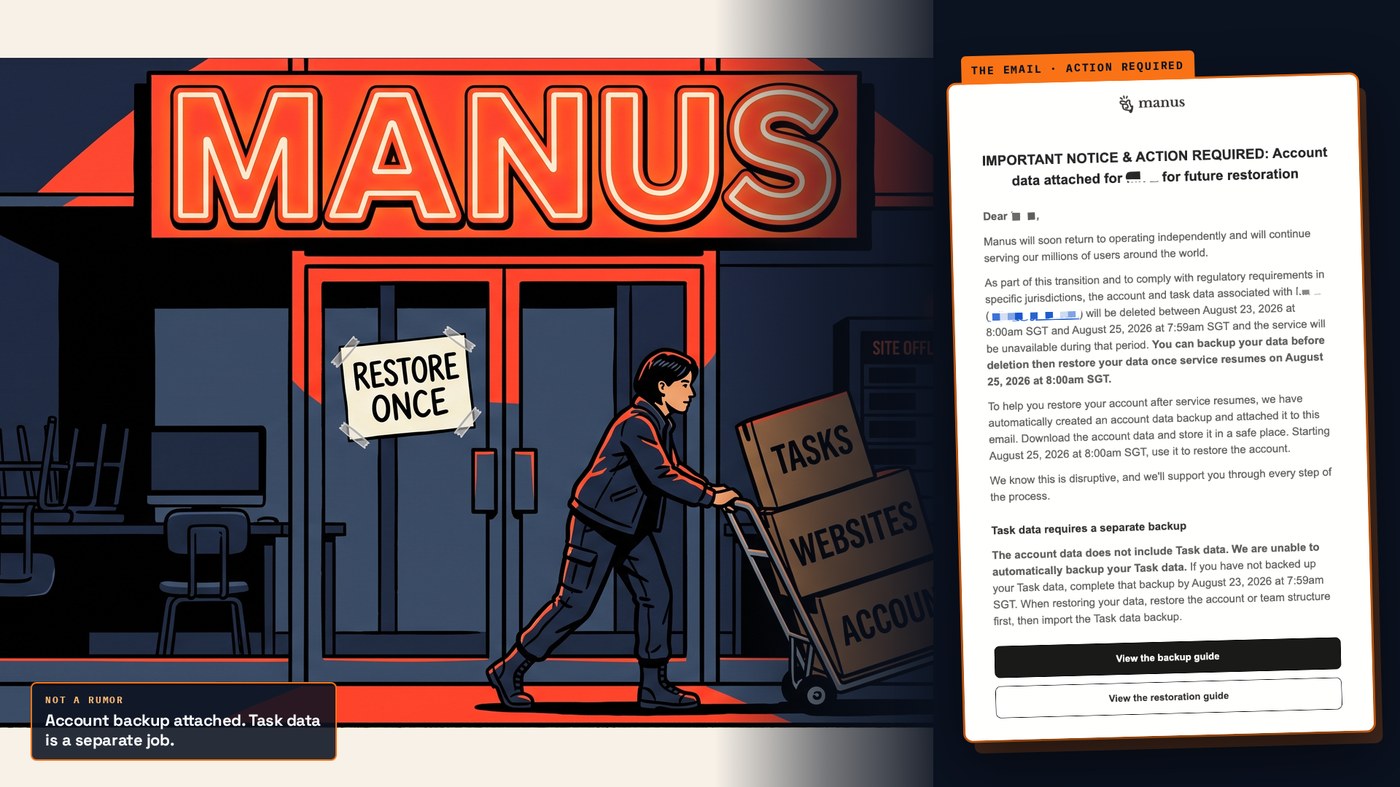
Last week a friend forwarded me an email she got from Manus. She’s been a paying user since last year, uses it to build research decks and small internal websites. The email told her that everything she created after December 29, 2025 was going to be deleted. Not archived. Deleted. The stuff from before the Meta deal is still there. Eight months of work after the deal is the part that has to go through the backup-and-restore gauntlet, or it doesn’t come back.
If you missed the backstory: Meta acquired Manus on December 29, 2025 for about $2 billion. In April 2026, Chinese regulators ordered the deal unwound. On August 11, Manus announced it would return to independent operation. And as a condition of the separation, data generated by affected users during the Meta period, which is to say roughly eight months of work, has to go.
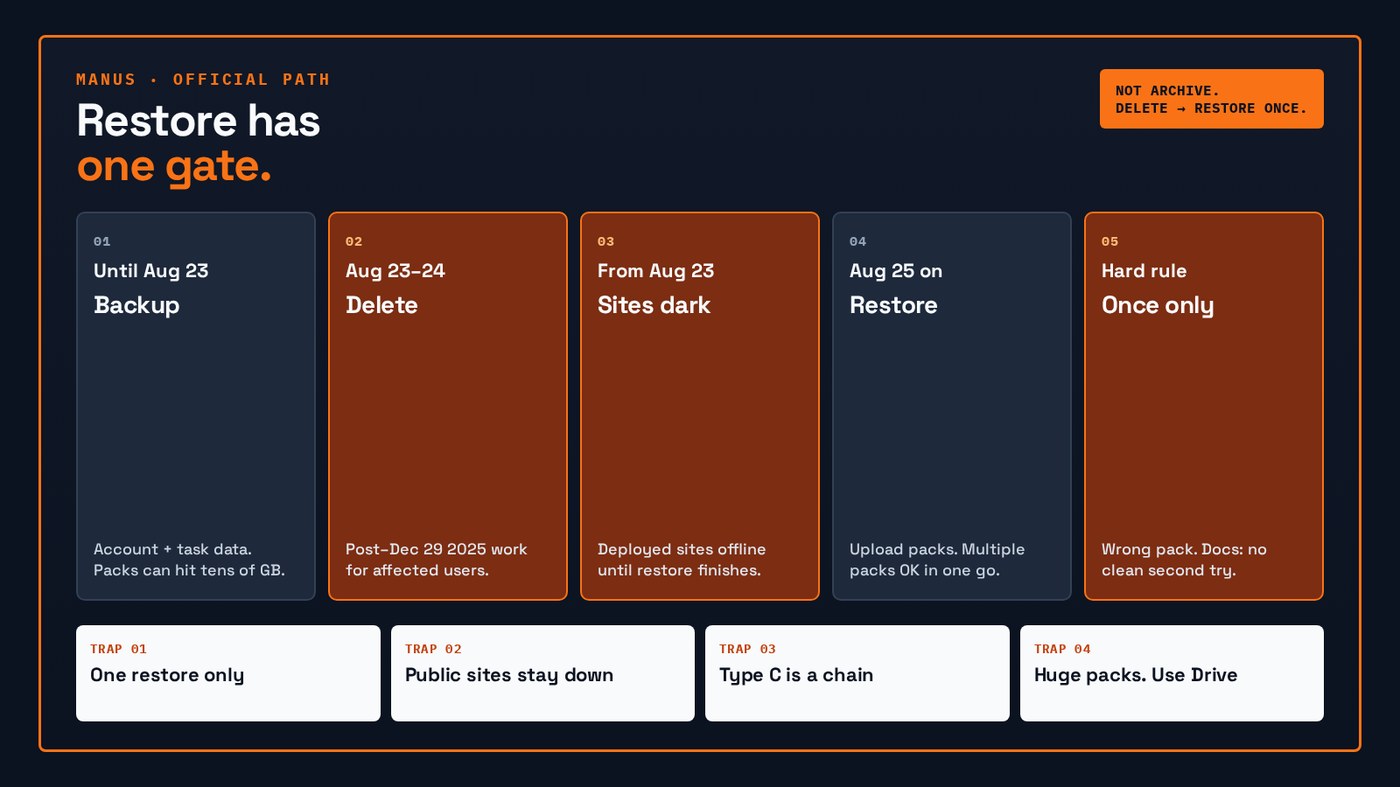
The official process sounds reasonable on paper. Back up your data before August 23. Deletion happens August 23 to 24. Restoration portal opens August 25. Upload your backup, get your work back, continue as if nothing happened. That’s the version in Manus’s note to users, and it’s the version Reuters and everyone else ran with.
I read through the actual help docs so you don’t have to. It is not as clean as the announcement makes it sound. And the “10 best Manus alternatives” posts that spiked on August 11 never priced in what happens when restore only works once.
Manus Backup and Restore Failed: The Fine Print Nobody Is Quoting
A few details from the official backup guide and restore guide that I haven’t seen anyone mention:
Restoration can only be completed once. This is stated explicitly in the restore documentation. If you upload the wrong backup package, or an incomplete one, that’s it. The docs recommend you “carefully check and confirm” your packages before restoring. There is no second attempt. If Manus restore failed because the package was partial, the official path does not hand you a clean redo.
Your deployed websites went dark on August 23. Anything you built and published through Manus is inaccessible until you personally complete the restore process. If you built a client-facing site on Manus, your client has been looking at a dead link since Saturday morning Singapore time. “Manus website down” is not a separate outage story. It is the same restore chain, hanging in public.
Some users lost their entire account, not just data. The docs describe a category of users (Type C) whose accounts get deleted entirely. For them, restoration is a three-step chain: restore your personal account first, then your team account, then your data. Each step depends on the previous one working.
The backups are big. Task data backups range “from tens of MB to tens of GB” according to Manus themselves, and they recommend exporting to Google Drive or OneDrive because direct downloads of files that size tend to fail. A backup process that needs a workaround in its own documentation is a backup process that will fail for a meaningful number of people.
None of this is me dunking on the Manus team. Reading between the lines, they got handed a brutal regulatory requirement and built the least-bad process they could in a few weeks. The refunds and the 24/7 support suggest people who actually care.
But I keep coming back to one thought. The problem isn’t how well or badly Manus handled the deletion. The problem is that the deletion was possible at all. That is also why “is Manus still safe” is a thinner question than it looks.
Poe, GPT-4o, Manus: Three Platform Failures, One Pattern
This is the third time in eighteen months I’ve watched users of an AI platform discover that their accumulated work wasn’t really theirs.
Poe removed its knowledge base feature earlier this year and every bot built on top of it quietly broke. I wrote about that as a packing list, not a ranking: what to take with you when the workspace job dies. OpenAI deprecated GPT-4o and people who had months of context and workflow tuned around one model’s behavior got migrated to something that responded differently. And now Manus, where the trigger wasn’t even a product decision but a geopolitical one that no user could have predicted or influenced.
Three different platforms, three different causes: a product pivot, a model lifecycle, a regulatory order. Same outcome for the user. The work you accumulated inside the platform turned out to be a guest, not a resident.
So when I see people searching for Manus alternatives this week, I think they’re asking a slightly wrong question. Not because you shouldn’t leave. Plenty of people should. The question isn’t which logo to move to on a “10 best” list written the day the press release dropped. The question is: wherever you move, where does your work actually live the next time a vendor, a model, or a regulator forces the room to change?
Why the Manus Data Deletion Marks First-Generation Agents as Over
Manus, credit where due, basically invented the category. A general agent with its own cloud computer that goes off and does multi-step work for you. When it launched in early 2025 it was genuinely ahead of everything.
But the architecture it pioneered has a structural flaw that the deletion just exposed at scale. Everything happens inside the vendor’s sandbox. Your tasks, your generated files, your deployed sites, your configuration. The agent is powerful precisely because it holds everything, and that’s also why losing access to it costs you eight months instead of eight minutes.
Call it the first generation: monolithic agents where the work product and the platform are inseparable.
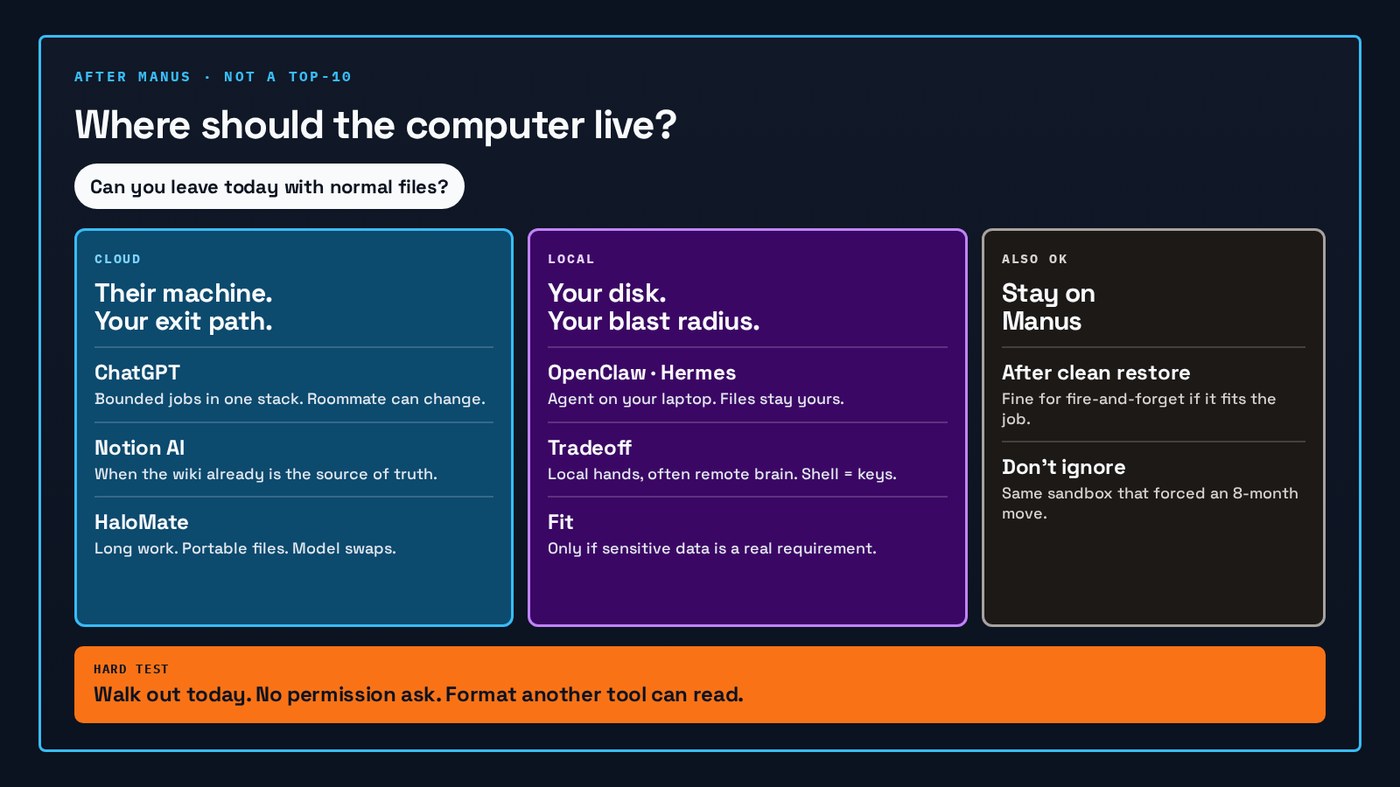
The second generation, which is roughly everything interesting that shipped in the past year, splits along one axis: where the computer is. If you’re still shopping Manus alternatives as if they were all the same shape of product, that split is the filter farms never use.
Manus Alternatives in the Cloud: Pick by Job Fit, Not by Ranking
Cloud agents still keep the “it just works” quality that made Manus appealing. No setup, no local resources, the agent has a real machine somewhere and you don’t think about it. What changed is less the logo fight and more what each product is actually shaped to do. The ones I’ve used enough to compare, same framing I used when I looked at local agents and stayed in the cloud:
ChatGPT is the default landing pad if one vendor’s stack already covers your week. Projects hold files, Custom GPTs cover persona, memory exists and you can prune it. Agent mode can chase a bounded research or build job and hand back something inspectable. If you were mainly using Manus as a contractor for discrete tasks and you’re fine living inside OpenAI’s walls, this is a legitimate Manus alternative, not a consolation prize. The fence is also clear: when the model you tuned around disappears, the room stays but the roommate changes.
Notion AI is attached to Notion’s data model. Team pages, company knowledge, the collaborative wiki people already live in. If your source of truth already sits there, running AI against that furniture is the low-friction move. It is optimized for that workspace, not for being a private multi-model workshop for every file that never got cleaned into the wiki.
HaloMate sits closer to a personal cognitive workspace with a real cloud computer attached. Projects and files stay put. Personas carry memory. Models work more like engines you can swap when one gets weird or gets deprecated. The same room can turn thinking into charts, docs, or runnable deliverables without treating your laptop shell as the sandbox. Less “finish this ticket and leave,” more “this is where ongoing work accumulates.” I’ll be upfront I’m biased, my day-to-day lives here. Honest caveat for a Manus refugee: it is collaborative more than fire-and-forget. If what you loved was launching a task and walking away for an hour, that interaction model is closer to ChatGPT Agent or staying on Manus after restore than to this.
None of these is the correct religion. ChatGPT is a strong fit when one model family is enough and the unit of work is often a bounded job. Notion AI is a strong fit when the center of gravity is already the team wiki. HaloMate is a strong fit when you want long-running private work to stay coherent across model swaps, without putting a shell agent on your whole machine identity. Pick for the job, not for the tribe.
Whatever cloud option you pick, including staying on Manus after you restore, apply one test before you commit: can you walk out with your work today, without asking anyone, in a format another tool can read? If the answer involves a special export tool that the vendor had to build under deadline pressure, you already know how this ends.
Open-Source and Local Alternatives to Manus: OpenClaw, Hermes, Sovereignty
The other response to the Manus lesson is to conclude that your agent should run on hardware you control. That’s the open-source / local alternative path: OpenClaw, Hermes, DeepSeek Harness, agents that live on your machine, see your files, can run a terminal as you.
That sounds like the opposite of “vendor can delete eight months.” In one important way it is. Your work product sits in folders you already own. Nobody’s acquisition timeline can wipe the disk under you overnight.
The tradeoff sits somewhere less obvious than the marketing pitch. Most of these tools are still local hands, remote brain. The agent packs context from your machine and ships it to a cloud model API each loop. You often cannot list exactly what left. And because the agent usually runs under your user account, a framework bug or a bad plugin inherits your ambient authority: home directory, SSH keys, cloud CLIs, sometimes browser sessions. OpenClaw’s auth-token-to-RCE class incident earlier this year was the neon version of that. Hermes and the newer harnesses keep shipping under new names on roughly a six-month fashion cycle. The brand changes. The blast radius question does not.
I wrote the longer version on why “is Hermes safer than OpenClaw” is the wrong question. Short version for a Manus refugee deciding in a hurry: local is the right call when you have a real reason to keep sensitive work off a vendor sandbox and you’re willing to think about permissions, VMs, and what the agent is allowed to touch. It is the wrong call if you mainly wanted “research deck + working prototype without babysitting infrastructure.” For that profile, start in the cloud column. Go local when the job actually demands it.
FAQ
Can I restore my Manus data more than once?
No. The official documentation states restoration can only be completed once. You can upload multiple backup packages in that single restore and Manus will deduplicate and merge them, but once the restore is done, it’s done. Verify your packages before you start.
What if Manus restore failed or my backup was incomplete?
Officially, there is no second restore. Multiple packages can be uploaded in that one attempt so Manus can merge and dedupe, which is why checking packages before you click restore matters more than any blog tip. If the restore already ran on a bad set, contact Manus support with expectations set: the help docs do not describe a user-facing redo. That is exactly why “restore failed” searchers should treat portability as a buying criterion on the next tool, not a feature request after the next incident.
Why is my Manus website down?
Deployed websites for affected users went offline at 8:00 a.m. SGT on August 23. They stay offline until you complete data restoration through the portal that opened August 25. There’s no automatic recovery, the restore has to be initiated by you, and the site comes back after your task data is restored.
What if I missed the backup deadline?
Manus says it auto-generated the account info backup for Type C users who hadn’t backed up, and emailed it as an attachment. Task data is a different story. If you didn’t manually back up tasks and generated files before the deadline, the official docs offer no recovery path for them. Contact their support, but set expectations accordingly.
Is Manus shutting down? Should I leave Manus?
No, Manus is not shutting down. It is returning to independent operation and has said it’s building new features. The deletion is a one-time condition of the Meta separation, not a wind-down. “Should I leave Manus” is still a fair question: if your work only lives inside a single vendor sandbox, you already lived through one forced move this month. Staying can be rational for fire-and-forget execution jobs. Rebuilding eight months on the same architecture without changing where artifacts live is a separate, worse bet.
What is the best Manus alternative right now?
There isn’t one list that fits every Manus refugee. For bounded contractor-style jobs inside one model family, ChatGPT Agent / Projects is enough. For team knowledge already in a wiki, Notion AI. For long-running personal projects that need portable files, memory, and model swaps without a local shell agent, HaloMate is where I landed. For true disk-level sovereignty and the security homework that comes with it, open-source local agents like OpenClaw / Hermes. Rank by job fit and exit cost, not by who published a “top 10” the week of the press release.
Is there an open-source alternative to Manus?
Yes, in the local-agent sense: OpenClaw, Hermes, DeepSeek Harness and peers. They replace “agent with a computer” better than they replace “I never want to think about ops.” Read the sovereignty section above before you treat open source as automatic safety.
The platforms will keep changing hands, changing models, changing terms. That part is out of your control and always was. The only thing you get to choose is whether your work is a resident of a platform or a guest with a packed bag. After this month, I’d pack the bag.