The short version
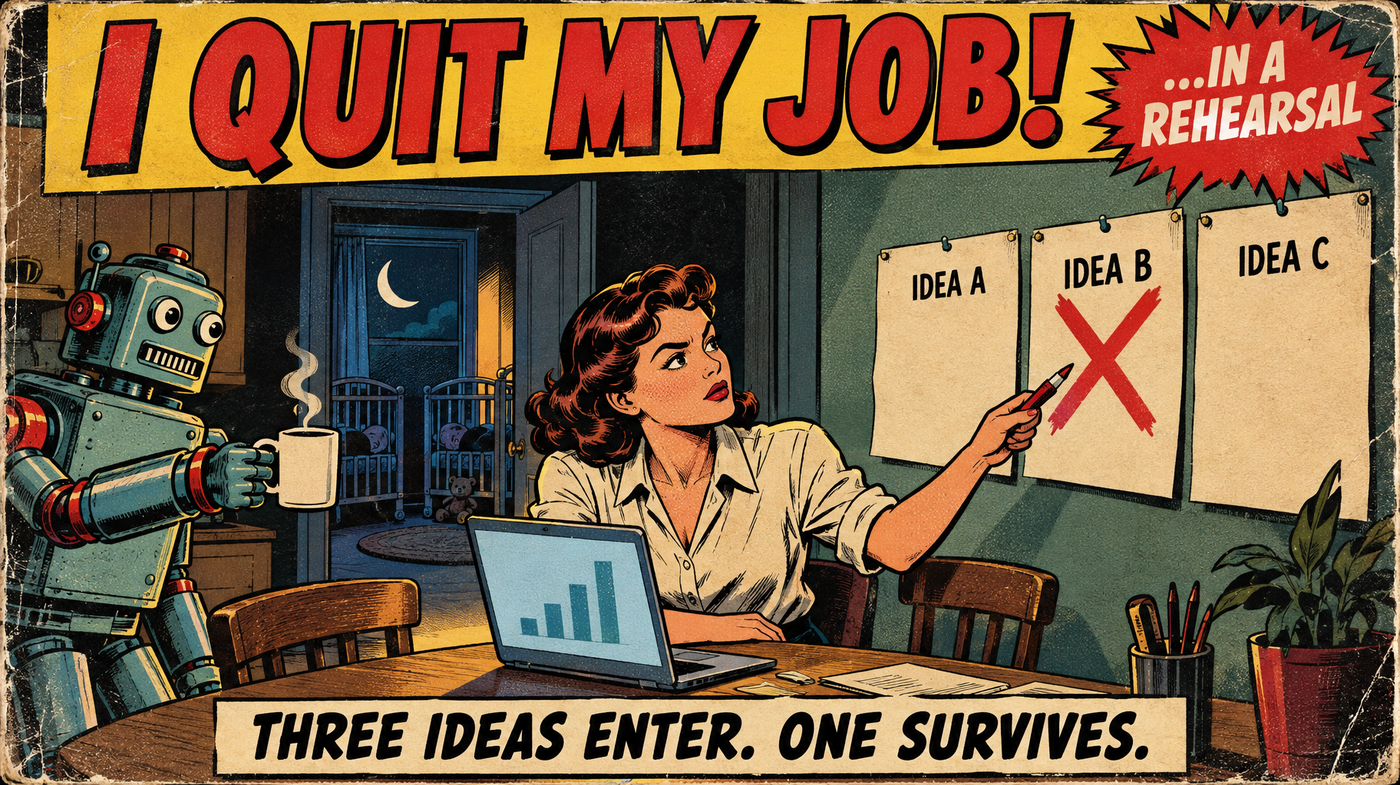
I haven't quit. I haven't picked an idea. But since June I've been running a weekly rehearsal for a one-person business, and the method is simple enough to fit in a paragraph: every candidate idea gets its own AI workspace, three rounds of stress testing (market, user, prototype), a second model checking the first model's conclusions, and a hard rule that nothing stays "promising" for more than three weeks. Two evenings a week after the twins are asleep. Most ideas die. That's the point.
The rest of this post is how it actually works, including the part I now think matters most, which is not the idea at all. It's where your own thinking lives.
The thought that started this
Somewhere around the third reorg in two years I caught myself doing a mental exercise on the commute: if the company disappeared tomorrow, who would pay me, for what, and how would I deliver it.
I didn't have a good answer. Fifteen years of product management, a pretty good relationship with AI tools, and a vague plan to "someday" semi-retire into something of my own. One or two things going. No meetings about meetings.
The problem with "someday" is that it arrives as a layoff email, not as a plan. So I made a rule. I'm not quitting, and I'm not even picking. But "what could I run alone" becomes a real project, with a weekly slot, a process, and a kill list.
Almost every "AI tools for solopreneurs" article assumes you already know what you're selling. I don't. What I needed was a machine for generating candidates, testing them cheaply, and killing most of them without feeling bad about it.
Step zero: your own workspace, not the one your company gave you
Before any idea, I did something that felt small and turned out to be the foundation.
I'd been using HaloMate for more than a year already, for work and for life. It's where I write the three versions of the same weekly report, where I plan the twins' summer, where I argue with myself about decisions. Multiple models in one place, projects that hold files, assistants (they call them Mates) with a persona and memory that persist across conversations. I've written about how I set those up in I Wrote an Employee Handbook for My AI Team. So the rehearsal didn't need a new tool. It needed a new project, and a decision.
That's my setup, not a recommendation. If you already live in Claude Projects or ChatGPT or Notion AI, most of what follows will map over without much trouble. I'm just going to walk through it in the one I actually use.
The decision: everything I've accumulated as a professional that is actually mine should live in a workspace I control, not in the enterprise Copilot or ChatGPT seat my employer assigned me.
I want to be careful here. I don't mean company documents, customer data, or anything covered by an NDA. That stays where it belongs. I mean the stuff that has no file: how I structure a decision, the questions I ask before I believe a market number, the way I write for an executive versus an engineer, the checklist in my head for reviewing a privacy impact assessment after doing forty of them. That's fifteen years of judgment, and I had been quietly training a company owned assistant on it. If I leave, the seat gets deactivated on a Friday and the judgment I taught it goes with it.
So the first two weeks of the rehearsal were not about ideas. They were about writing my own thinking down as personas and reference files in my own workspace. It's the most useful thing I did all summer, and I'd recommend it even if you never start anything. Your employer owns your output. It doesn't own how you think. Put that somewhere you hold the keys to.
The three candidates I started with
They're unglamorous because they came out of my own life, which is the only place I have real user knowledge.
Candidate A: a low anxiety early learning platform for parents of 0 to 3 year olds. I have twins. I've spent an embarrassing amount on subscription boxes and apps telling me what my kids "should" be doing this month. Most are either generic or quietly stressful.
Candidate B: a chore and mental load splitting tool for dual income couples. Also from my life. Also from about four arguments.
Candidate C: privacy documentation for small companies. Privacy policies, data processing records, privacy impact assessments, drafted properly for founders who can't afford a law firm and shouldn't be pasting a template off a generator. Not legal advice, drafting work that a lawyer can review in an hour instead of ten. I've sat on the product side of these reviews for years and I know exactly where the templates fall apart.
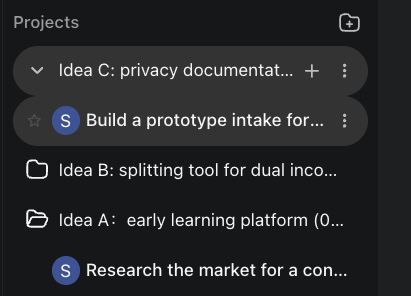
Each one got its own project. Concept notes, research, and every conversation about that idea live in one place, so nothing has to be re-explained and the Mates working inside it start with the full picture.
One project per idea.
Round 1: does the market exist, and is anyone paying
Question: is anyone already paying for a version of this, and how big is the real category once you strip the slide-deck TAM?
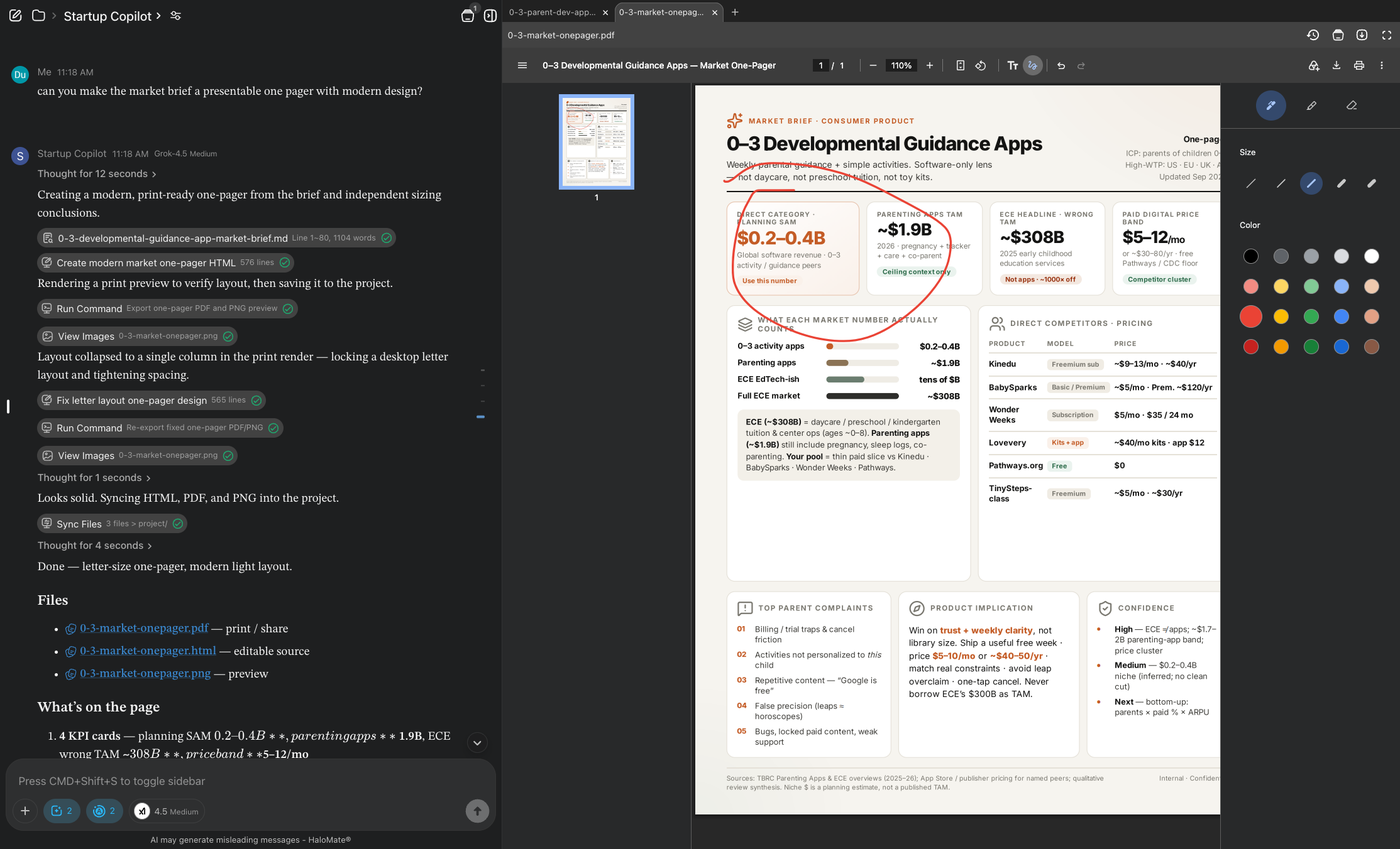
What I did: same brief for each candidate (who else does this, what they charge, how big, what users complain about). One research Mate per project. Then a second model on the same files, same question, no copy paste.
I'll stay on Candidate A. It's the one that surprised me.
I have a Mate in that project called Startup Copilot. Nothing fancy, its persona is basically "a cofounder who has read too many pitch decks and doesn't believe any of them". I gave it the brief and let it run on autopilot while I put the twins down. It ran eight or nine searches on its own (market size, competitor pricing pages, review complaints) and came back with a document that had something I hadn't asked for: a confidence legend. High confidence for numbers pulled straight from pricing pages and named reports, medium for cross checked secondary sources, and "inference, do not treat as a published statistic" for its own synthesis.
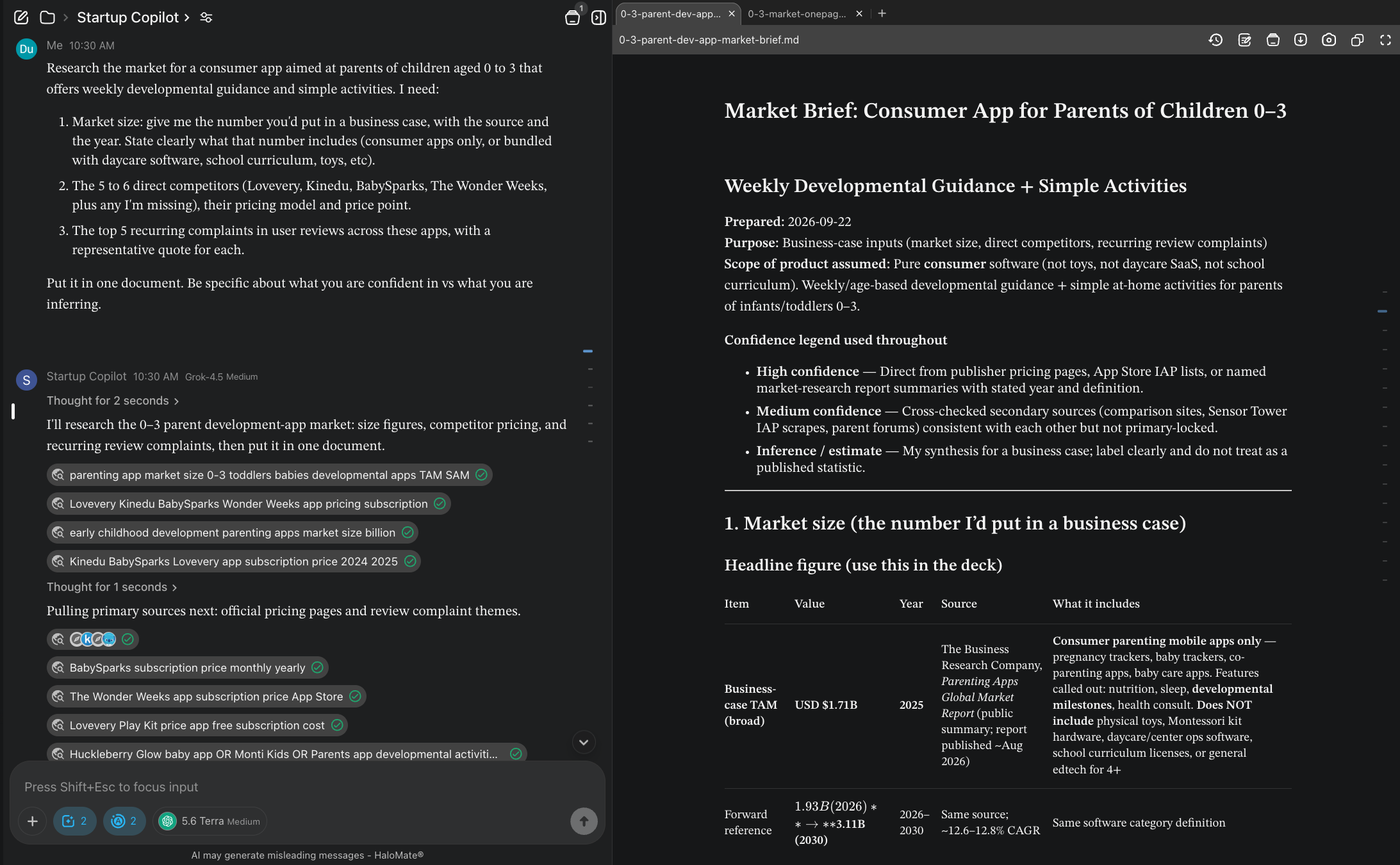
Then I asked it to turn the brief into a one pager. Four numbers across the top:
- ~$308B: the "early childhood education market" figure you see in every deck. Daycare, preschool, curriculum, center operations, ages 0 to 8. Labeled by the model itself as "wrong TAM".
- ~$1.9B: consumer parenting apps, software only. Pregnancy trackers, sleep logs, co-parenting apps, everything.
- $0.2 to $0.4B: the actual category I'd be in. Developmental guidance and activity apps for 0 to 3.
- $5 to $12 a month: what people currently pay, with a hard free ceiling from Pathways.org and the CDC milestone content.
Three orders of magnitude between the number that gets you excited and the number you can actually sell into. I circled the small one in red and left the big one on the page as a reminder.
Then the step I now consider non-negotiable: a second opinion from a different model, right there in the same project, on the same files. No copy paste, no re-uploading, just switch the engine and ask again. I asked a sharper question this time. Given this brief, if you were building this alone, which lane would you pick?
I expected disagreement. I got something more useful: convergence from two different directions. Claude walked through three lanes in a scoring table and rejected the generic "weekly plan for your baby" outright (Kinedu and BabySparks already own it, free content sets the ceiling, six to twelve month natural churn). GPT skipped the table and went straight to a recommendation with an ideal customer profile. Both landed on the same lane I hadn't considered: not a parent app at all, but a handoff tool for dual income households where a nanny, grandparent or au pair executes the day and the parent is the buyer who wants to know it was intentional. Nine to twenty four months. Claude also floated a "late talker" lane and flagged the liability problem in the same breath.
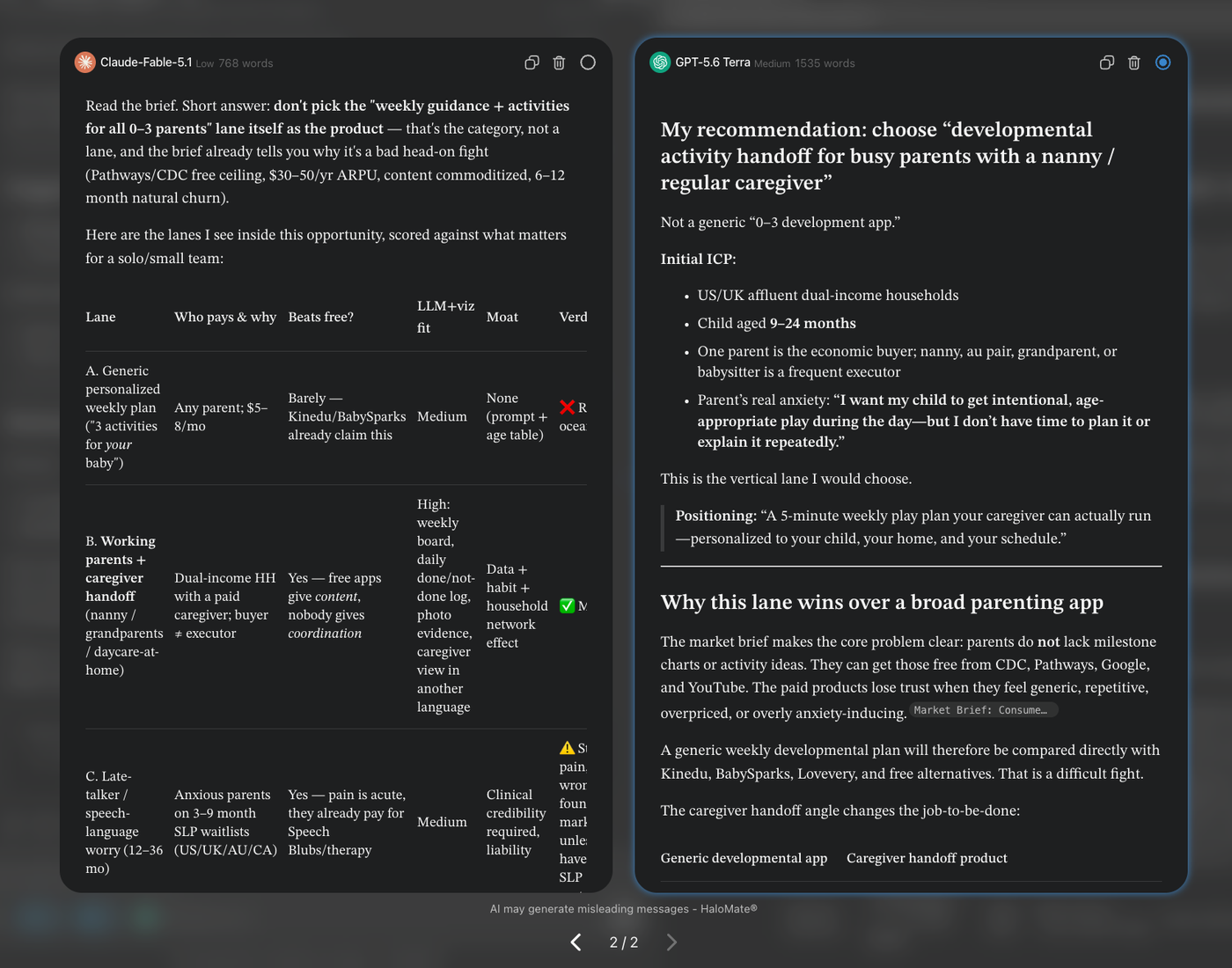
This is the first place where a single ChatGPT or Claude subscription quietly fails you. You can check one model against another. You open a second tab, re-upload the brief, re-explain the idea, and ask. Nobody does that on a Tuesday night. I know because I didn't, for a year. When the second opinion is a dropdown on the same conversation, you actually do it. And when two engines with different training and different habits arrive at the same narrow lane, you can trust it in a way you can't trust one enthusiastic answer. When they split, that's information too. Either way you learn something you wouldn't have learned from one.
Verdict, Round 1:
- A survived, but not as I pitched it. Weekly guidance for anxious parents is a crowded lane with a free ceiling. The version that survived is the caregiver handoff. Lovevery, Kinedu, BabySparks and The Wonder Weeks all charge real money. Top review complaints: billing and trial traps, content not personalized to this child, repetition ("Google is free"), false precision that reads like a horoscope. None of them are built for the person who actually spends the day with the kid. Gap, not a wall.
- B died here. Every competitor free or nearly free. App store reviews full of couples who lasted nine days. Willingness to pay roughly zero. The real product is a conversation, not software. Off the board.
- C survived on a short pass. Termly, iubenda and TermsFeed own "generate a policy in five minutes". Nobody small owns the next layer: assessments and records a founder needs the week a bigger customer sends a vendor questionnaire. State law count keeps climbing. I parked C and stayed on A. It comes back when the process needs a different shape of prototype.
Round 2: who is the user, really, and what do they do today
Question: for the version of A that survived Round 1, who is actually the user, and what would make them delete the app in a week?
What I did: two opposed personas in the same project, both reading the Round 1 files, both remembering across evenings. Then swap the engine under one persona and listen for what changes.
For Candidate A I am the user, which is dangerous. You can't interview yourself and get a straight answer.
So I set up two Mates with deliberately opposed personas. One is a skeptical parent of a toddler who has been burned by three apps and thinks milestone charts are a scam. The other is a child development specialist who cares about what the research supports and gets irritated by marketing claims. Both read the same project files. Both remember, across evenings, what they've already said.
Then I let them argue about the caregiver handoff. The skeptical parent killed two of my favorite features in ten minutes ("I don't want another notification telling me my kid is behind, and I definitely don't want my nanny getting one"). The specialist pushed back on anything implying a fixed weekly schedule, because the developmental range at eighteen months is enormous.
Here is the second thing a single model subscription can't really do. Yes, you can build a custom GPT or a Claude project with a persona. But you get one engine under it, and the persona and the files don't travel. I ran the skeptical parent on Claude one night and on GPT the next, same persona, same memory, and got two different flavors of skepticism. The Claude version worried about my kids' privacy. The GPT version worried about my pricing. Both were right. Persona is the asset, model is the engine, and being able to swap the engine under a persona you've spent weeks shaping is worth more than any single model's IQ.
Verdict, Round 2: A got smaller and better. Not "what your child should be doing", but a five minute weekly plan a caregiver can actually run, written so the parent reads it as "here's what to notice" rather than "here's where you're behind". Low anxiety by design, for both adults. Still alive. B already dead. C still parked, still looking like a service more than a product, which is the whole point of keeping it.
Round 3: can I make something clickable in one weekend
Question: if I make the idea concrete in one evening, does it still feel worth building, or does it go boring the moment it's a real screen?
What I did: one evening prototypes inside the same projects that already held the research and the hostile personas. A got a quick concept page. C got the longer treatment, because that's where the process taught me something A couldn't.
This is the round that changed my mind about what starting something costs.
For A I already knew the tone. The skeptical parent had approved it, the specialist had caveated it, and those files were still in the project. I described a weekly plan page organized by month: three short activities a caregiver can run, a "what to notice" note for the parent, no scoring. Working single page with live preview in an evening. I showed it to two parents at daycare pickup. Both asked when it launches. Neither asked what it costs. Good sign, and a warning. A survives as a concept. I didn't need another night on the UI to know that.
C is where Round 3 actually earns its keep. The prototype wasn't a page. It was an intake. The real work in privacy documentation is asking the right questions before writing a word. I described a five section form that adapts as you answer (say you take payments, it asks about the processor and retention; say you have EU users, it branches into legal basis and cross border transfers; say California, it goes CCPA) and asked for a summary at the end listing which documents you'd need and your three biggest gaps.
What came back was better than the brief. The model planned the question flow first, then built it, and instead of a summary at the end it put a live panel down the right side: "Your documentation plan", updating with every answer. Five questions in, an Australian company selling to both consumers and businesses already had Privacy Policy marked required, Record of Processing Activities marked likely, and Privacy Impact Assessment, Cookie Notice, CCPA and the vendor questionnaire pack sitting at "not yet" waiting for the answers that would trigger them. One of the first questions was "do you already have any privacy documentation in place?", with "a generic template we copied" as an option. That's the customer, in one radio button.
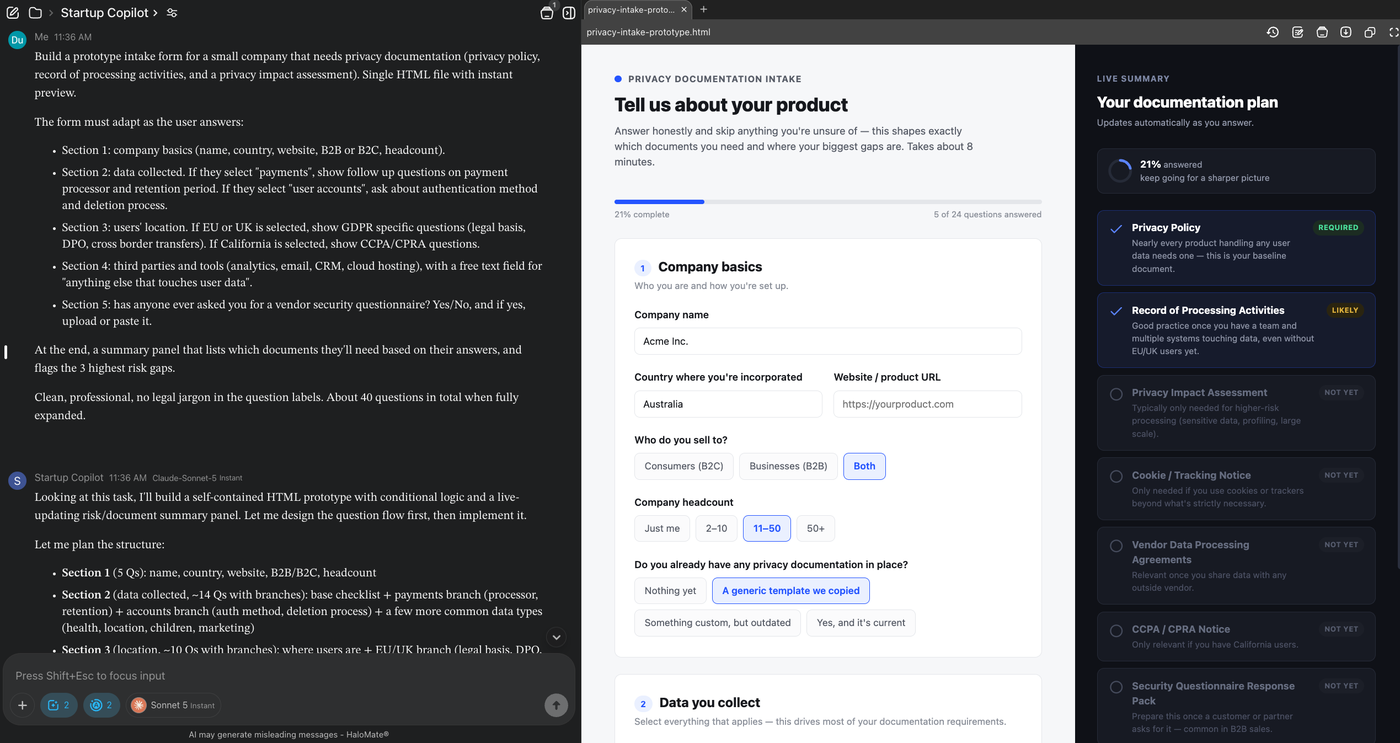
My privacy-lawyer Mate reviewed the question set in the same project and flagged three things a template would never ask about, all of them about what data the company actually touches rather than what the law says. Same room as the Round 1 research. No re-briefing who the client is.
Honest concession: Claude's Artifacts and ChatGPT's Canvas will also render you a clickable page. ChatGPT Projects and Claude Projects will hold your files too. The difference is what happens to those files after you upload them. In most setups the file is a reference the model can read. In this workspace the file is a living thing inside the project. You edit it, the AI edits it, versions stick around, and next week's conversation picks up from the version you actually settled on, not the PDF you uploaded three weeks ago and then forgot which draft was current. That is the part that made the rehearsal feel like work instead of demos. The persona who criticized your concept last week can open the same file this week, mark it up, and hand you a revised one-pager without anyone leaving the room. Regenerate the design with a different model when the first one gives you a landing page that looks like every other landing page. The loop closing on shared, editable files is the feature. The preview is just the last step of it.
For anything past a concept, Lovable, Bolt or v0 will build you something with a real database. I haven't needed that. Round 3 isn't for building the product. It's for finding out whether the idea survives being made concrete. B, if it had made it this far, would have become visibly boring the moment it was a real screen.
Verdict, Round 3: A still alive as a product-shaped bet, cheap to sketch, still untested on strangers. C very much alive as a service-shaped bet, and the intake made the first invoice feel closer than any parenting app mockup ever did. Different shapes. Same three-round filter.
What's alive, what's dead, and the question I didn't expect
Dead: B. Nobody pays, and the problem is a marriage, not a market.
Alive: A and C. Both survived three rounds, which means both earned a fourth evening. That's all it means.
And this is where the rehearsal produced a question I didn't set out to answer. A is a product. C is a service. A could someday run while I sleep. C is billable hours that I'd have to keep showing up for, but it could invoice its first client next month. For a "semi-retirement" plan those are opposite shapes, and I genuinely don't know which shape I want yet. Six weeks ago I would have said product, obviously. Now I'm less sure, because C is the one where fifteen years of judgment is the moat, and A is the one where being a tired parent is.
That split only showed up because I let two different ideas finish the same machine. If I'd only rehearsed A, I'd still be telling myself the answer is "build an app". If I'd only rehearsed C, I'd be drafting a services landing page and calling it a plan. Keeping both on the board is the point of a kill list that isn't allowed to stay sentimental.
Next round, the one I've been avoiding: talk to ten strangers for each. AI plays a skeptical parent and a tired founder surprisingly well. It cannot be either.
I'm also aware of the much quoted CB Insights finding that the top reason startups die is no market need. The number is old. The shape of it is why I do Round 1 before letting myself get attached. The MBO Partners State of Independence report counts over 72 million Americans doing some form of independent work, and I'd bet most of them didn't start with a business plan. They started with a rehearsal, whether or not they called it one.
I haven't quit. I haven't picked. But "someday" has a workspace now, a weekly slot, and a body count. And my own thinking finally lives somewhere my employer can't deactivate. That feels like progress.
Questions I got when I described this to colleagues
How do you validate a business idea with AI without fooling yourself?
Ask twice, with two different models, on the same files, and give the second one no access to the first answer. Then set up a persona whose job is to hate the idea and let it remember what it hated last week. If the idea survives that, go talk to real humans. AI is for cheap early kills, not for final yeses.
Can you build a prototype without coding?
For a concept page or a smart intake form, yes, in an evening, with instant preview. For anything with accounts and data, tools like Lovable or Bolt get you most of the way. Neither replaces knowing what you're building. They make the "is this real" question much cheaper to ask.
Should I start a one-person business before quitting my job?
Start the rehearsal before quitting. Not the business. Give ideas a workspace, a fixed number of evenings, and a process that kills them. If something survives three rounds and ten strangers, you'll know, and you'll have kept your salary while finding out.
What actually belongs to you when you leave a job?
Not the documents. Not the data. The judgment: how you decide, what you check, how you write for different rooms. Write that down as personas and reference files in a workspace you own, before you need it. It's the one asset that transfers.
If you're running a version of this rehearsal, I'd genuinely like to know what's on your kill list.